Showing posts with label Organic. Show all posts

Wednesday, November 25, 2020

The European Union's Wine Grape Quandary


The European Union has recently published a lengthy "Farm to Fork Strategy" which sets out ambitious goals for its agricultural sector. One part of the agenda is to reduce the use of pesticides either by restricting the way they can be used or in many cases by not authorizing their continued use when those particular chemicals come up for periodic review by regulators. Often these restrictions are at odds with the rigorous safety assessments that have been made by many regulatory bodies around the world including the US EPA. Another part of the agenda is to encourage the expansion of Organic farming. There are several reasons why this plan will cause serious complications for European farmers, and since the EU is a major importer of food, feed and fiber crops, the restrictions that it applies to various grape pesticides will also be a problem for farmers around the world who export their crops to the EU market.


Many crops will be affected by this agenda, but one interesting case-study is what this push will mean for the prominent and highly regarded wine grape industry in the EU.  Wine grapes only represent around 3% of EU farmland, but around 20% of total EU pesticide use. There are several reasons for this relatively intensive use of crop protection products.  For one thing wine grapes are a very high value crop so growers can afford to use more products to optimize the yield and quality of their fruit. But there are also important historical and genetic reasons why certain pests represent a particular challenge for the European grape industry. 


With most crops, breeding is an important strategy to help with pest problems, notably when that involves tapping into the genetic diversity available in various wild relatives of the cultivated crop. With wine grapes the breeding option has essentially been "off-the-table" because of the long tradition which has identified very specific Old World grape varieties of the species Vitis vinifera which have been found to provide the highest quality for the weather and soil conditions of each growing region or "appellation." The long-term history and tradition of growing specific grape cultivars in each region is often called "terroir" and this is not anything the industry wants to change because it needs to meet consumer expectations and marketing narratives about wine quality.


Interestingly in the 1870s there was a dramatic change to the genetics of European grapes.  A root feeding insect called Phylloxera was inadvertently transported to Europe from North America. The various wild species of grapes that evolved alongside Phylloxera are fairly resistant to the damage from that specific insect pest. (The most familiar example of this kind of grape is a species called Vitis labrusca which consumers know as Concord Grapes because that is the kind of grape used to make non-alcoholic grapes juices such as the famous brand - Welches). The native American grapes are not considered to be that good for making high quality wines, but some hybrids between the two species are grown for wine in the Northern US in areas that are too cold for Vitis vinifera.  The Vitis vinifera grapes of Europe evolved without the challenge from Phylloxera so once the pest crossed the Atlantic the vineyards were highly susceptible to its damage and began a steep decline.  The only way the industry was able to be saved was by grafting the vinifera cultivars onto "American Rootstocks."  Grafting is a horticultural technique that has been practiced for centuries, but it was only with great reluctance that the European growers took that step. 


A grafted grapevine, image from Washington State University Extension


Around the world today virtually all wine grapes are grown on these "American" rootstocks because they can provide protection from soil-borne pests while allowing the traditional varieties to achieve the desired fruit qualities that made them so desirable. Rootstocks are used for almost all perennial crops and also for high value vegetable crops like fresh market tomatoes.


There are also two serious foliar diseases that also made the jump from North America to Europe in the 1800s. The first was a disease called Powdery Mildew and it causes loss of yield and quality as it grows on the exterior of the leaves and fruit.  Vitis vinifera is highly susceptible to this disease.


Grape Powdery Mildew infection of a developing grape cluster. Photo by Laura Jones/Univ. California, Davis


The solution that was found is probably the oldest known pesticide, elemental Sulfur.  This "natural" mineral product was found to control the disease but only if the grapes were "dusted" with something like 10 pounds/acre of sulfur every 7 to 10 days for much of the season until the fruit begins to ripen (a stage called veraison in grape-speak).  Sulfur is not very toxic to eat or drink, but it is an eye and skin irritant that can make it quite unpleasant to work in a vineyard. There is also some evidence that as with other dusts, sulfur can increase the risk of asthma among the children who live near the places were dust products are applied. California has recently restricted the use of sulfur and other dusts near populated areas. "Wettable" forms of sulfur can still be used without the respiratory problem and that is still a part of integrated pest management systems for grapes.  However; most modern grape growers use sulfur more sparingly because newer and more effective "synthetic fungicides" have been developed which require far smaller doses at longer intervals and which are in the EPA toxicity class IV described as "essentially non-toxic" by ingestion. I remember a time in 1978 during my second season being out in California vineyards for my graduate research that I was amazed to smell a beautiful floral aroma during the grape bloom period - something I had not experienced the season before. It was because I was in a block treated with the first example of these new fungicide options instead of the normal odiferous and irritating sulfur. I have a podcast about that event.  Grape growers who choose to grow for the organic market are not allowed to use these more modern tools and must therefore depend on high use-rate options like sulfur and something called "petroleum distillates" (think mineral oil for the later).  Thus, this is just one example of how the EU Field to Fork strategy embodies conflicting goals if it wants to reduce pesticide use and the push for more organic production.


Grape Downy Mildew sporulating on the bottom of a leaf. Photo by Mark Longstroth, Michigan State Univ. Extension

There was another "intruder" fungus pest that originated on North American grapes and then caused even more severe problems for the European industry in the 1870s.  It is called downy mildew.  The solution that was ultimately found to this disaster was another very early pesticide. It was discovered by a French botanist named Pierre Millarday who noticed a particular vineyard along a roadside that stood out by exhibiting much less damage from the new disease. He learned that the grower had applied copper sulfate combined with lime as a way to make the fruit look unappealing so that people passing by would stop helping themselves to his grapes (you can see an image of this blue coating in this article in Wine Spectator).  


That "natural" pesticide became known as the Bordeaux mix and it saved the grape industry.  It was also a much-needed solution for a related disease on potatoes that had cause the famous Irish Potato Famine in the same era.  Various copper-based products do work against these pests and many are approved for use in organic production, but unfortunately they are quite toxic to aquatic organisms and are persistent in the environment since the mineral copper is copper and it isn't going to break down to innocuous components the way that many other natural or synthetic chemicals do over time. After years of use, copper fungicides build up in vineyard soils and can become toxic to grape roots. Many European organic growers have had to abandon their organic status because of these soil issues.  Copper fungicides also require high use-rates (4-6 pounds/acre) and frequent applications because the copper is easily washed off by rain. 


Once again, many low toxicity, highly effective and environmentally safe synthetic fungicides that have been developed to fight downy mildew, but those options are not allowed to be used by Organic growers. European regulators are not fans of these copper fungicides, but their politicians have made exemptions for their own grape growers while at the same time setting up barriers to more benign products that have met rigorous standards in other countries.  


Organic growers also have limited options for the control of mold fungi that can infect the grapes as they become ripe. That sort of "bunch rot" is very bad for wine quality, but a disease that is well addressed with safe, modern synthetic fungicides while organic growers still depend on things like copper. Chemical herbicides are also desirable for grape production so that there isn't a need for erosion-causing mechanical plowing to take care of weeds in the vine rows. Tillage is still the main option for Organic growers. So, in all these cases the EU's pesticides and organic goals are in conflict with one another when it comes to that iconic industry


As mentioned earlier, there are several wild grape species that are more resistant to powdery and downy mildew. Theoretically traditional breeding methods could be used to transfer some of those genes. Conventional breeding of grapes is possible but slow, and it has been used to develop things like seedless table grapes with new colors and flavors.  Some new wine grape varieties with disease resistance from wild grapes have been developed by breeders working for the University of California, and they were repeatedly "back-crossed" so that the final result was a variety with 95% vinifera genes. But because of tradition and some remaining wine quality questions, almost all the wine grapes of that state and other grape growing regions around the world are still the traditional European varieties.


With modern genetic technologies it is now possible to work with only one or a few genes from the wild grape species that confer pest resistance and do so without any effect on the thousands of other genes in the storied cultivars. This sort of precision is now much more feasible because of the genome editing technologies that are generating excitement for many applications in both medicine and agriculture.  But the EU as a whole has been very resistant to accepting "GMOs" methods even though their own scientists have long argued that such changes do not represent any greater risk to public health or the environment than do traditional means of breeding. Scientists at Rutgers University and with the USDA are working now on using this approach to get downy mildew resistance into Chardonnay. 


There is some hope in the scientific community that European activists and political authorities will take the logical step of saying that they can consider these modern genome editing technologies differently from how they responded to first generation genetic engineering methods. There is at least a promising mention of such technologies in the EU's Farm to Fork Strategy


"In response to the request of Member States, the Commission is carrying out a study which will look at the potential of new genomic techniques to improve sustainability along the food supply chain."


Some are even optimistic that traditionally anti-GMO groups will make a distinction for the new methods. Ideally the EU might take reasonable approach of combing state of the art genetics with the sort of low hazard synthetic chemical options that would still be important in order to avoid selecting for fungal resistance to traits a grower would need to last for decades in a new vineyard planting.  That would also relieve the wine industries in other countries from having to cater to EU trade barriers in the choices they make about how to produce their crops.


Europeans are not likely to abandon their taste for wine and they don't have to in order to pursue their legitimate goals.  Organic isn't the solution here.  Instead what is needed is respect for the science and more effective communication of the actual safety story behind modern agriculture.  There is an excellent explanation written by the European Food Safety Authority (EFSA) that describes how robust the approval system is for safe pesticide standards, and this is confirmed by academic experts as well. But all too often in Europe, politics trumps science. Let's hope we might someday raise a toast to a more constructive and science-driven solution to the EU's grape quandary.




Monday, October 7, 2019

Don’t buy organic food if you want to seriously address climate change


As we approach the 2020s, many consumers have accepted the marketing/activist narrative that organic farming would be the best option for food safety and to mitigate the most damaging effects of climate change. The inconvenient truth is that organic farming is a terrible option from a climate change perspective. Its dependence on manures and compost involves huge, but rarely recognized, greenhouse gas emissions in the form of very potent methane and nitrous oxide.
But perhaps its biggest climate change issue is that organic farms are mostly less productive per unit area than “conventionally” farmed land. With rising food demand driven mostly by rising standards of living in the developing world, there is a need to boost farm production, and that means the very undesirable conversion of forests or grasslands to agriculture in places like Brazil. That leads to major carbon dioxide release from what had been sequestered carbon in the soils, and also the loss of biodiversity and other environmental services provided by those natural lands.
Background on “organic” farming
The organic farming movement started in the late 1800s and early 1900s in response to issues that had arisen in plough-based agriculture, which had converted most of the prairie land in the American Midwest to farmland through the process of sod-busting.
Spurred by the Homestead Act, Americans moved to the Midwest to claim their 640 acres of government land give-away. Most used the new polished steel plow made by the John Deere company to turn what was once a diverse grassland ecosystem into what became one of the most productive agricultural regions in the world. However, the way that these farmers needed to control weeds and make the land suitable for planting was to mechanically disturb the soil, and that lead to the death of many soil organisms and the breakdown of the organic matter that they had made using the energy supplied by the plants that grew there.
Over time, as the soil was degraded by this tillage, it became less fertile, less able to capture and store rainfall and less productive. The common solution was often to move on to “virgin” land and do the same thing to the biome there.
The true innovation of the early organic movement was the realization that for a soil to remain productive over time, the organic matter content of the soil had to be replenished after each crop harvest. The movement’s solution was to import large quantities of organic matter from other sites in the form of the manure or composted manure from the animals fed on those other agricultural acres. This worked, but it was never, nor is it now, a viable solution for US or global agriculture.
Even so, starting with the Rhodale Institute’s publication of “Organic Gardening” magazine in the 1960s and the eventual establishment of a commercial organic industry in the 1970s, the mostly non-farmer consumers in US society were told the story that organic farming was the best way to both feed us and protect the environment.
In 1990, the USDA (US Department of Agriculture) was charged by Congress with establishing a national organic standard to supersede the fragmented certification systems that had evolved to that time. It was a major struggle because the very science-oriented USDA was at odds with the early organic marketers who had focused entirely on the narrative that what is “natural” is always best. The marketers finally prevailed. When the national organic standards were issued in 2002, they were not based on science but rather on the naturalistic fallacy.
unnamed file
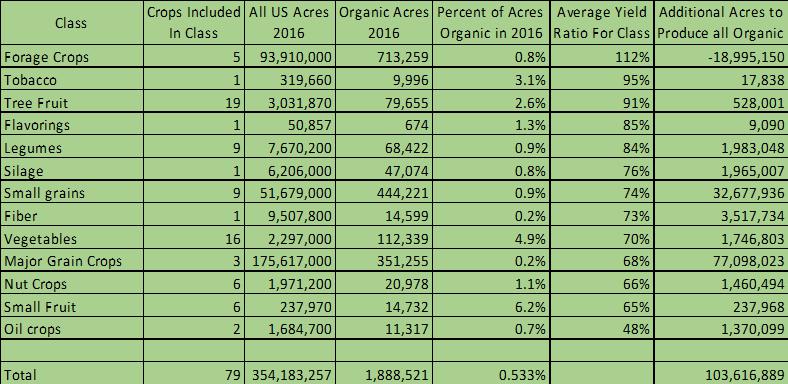
2016 US Crops By Class

So here is the big picture. The only crop category for which organic yields were higher than the 2016 US average was for forage crops for feeding animals. To have produced all of the US agricultural output from 2016 as organic would have required more than 100 million more acres to have been farmed—an area greater than that of the entire state of California, the third largest US state. That amount of new land suitable for farming clearly does not exist in the US, and so that shortfall would induce more conversion of forest and grassland into farming in places like Brazil, leading to major releases of previously sequestered carbon in those soils

US Forage Crops 2016

There were higher yields for organic Hay and Haylage for animal feed in 2016, but for other animal feed crops, the organic yield was quite a bit lower. 17.1 million acres of alfalfa is grown for hay, mainly to feed dairy cattle. 1.71% of that land is in Certified Organic acres. Most of that land is much less productive.

Plant-based protein in an important component of the human and animal diet, but only relatively minor crops like pinto beans and Austrian Winter beans had higher yields as organic crops in the 2016 season. Nearly 2 million additional acres would have been needed to produce these crops as “Only Organic.” This is in spite of the fact that these crops require much less nitrogen fertilization, because they have an association with soil bacteria that fix atmospheric nitrogen for them in trade for energy.


Corn, soybeans and sorghum grown for grain accounted for 50% of all US crop acres in 2016. These crops provide most of the feed and biofuel for the US, as well as many major food ingredients. To have produced these crops as organic would have required 77 million acres to be farmed, something that would drive major land use conversion in places like Brazil and the associated climate and biodiversity impacts of that change.

Small grains are a major part of the human diet. With the exception of the relatively small crop rye, these plants do not yield very well in organic systems. To have supplied the domestic and important global market for these grains as organic would have required 33 million more planted acres, an area comparable to the entire state of Arkansas. Since many of these crops have quality issues associated with where they are grown, there really aren’t places in the US or the rest of the world where this could happen.

The only vegetable crop for which organic yields were higher was sweet potato. Organic represents 4.9% of total vegetable acreage in the US – much more than the overall 0.5% for all crops. Since many vegetable crops do best in specific climatic zones, that significant current organic footprint probably serves to raise overall prices for consumers, even if they do not purchase organic. When that issue is added to the fear of pesticide residues on vegetables driven by the Environmental Working Group’s “Dirty Dozen List,” this only contributes to the missed health advantages of vegetables in the diets of many consumers.
To have produced all the 2016 US grown vegetables as organic would have required 1.75 million more acres to be grown—something clearly not possible.

Tree nuts are considered to be a very healthy component of the diet, and may even reduce overeating that causes obesity because they make consumers feel full. These crops only flourish in certain climates, so there is no possibility that they could all be raised as organic. That transition would require 1.5 million more acres to be dedicated to those crops.

Organic yields of small fruits are often much lower than the national average. This is particularly true for strawberries, cranberries and wild blueberries. The one exception is tame blueberries, mostly in Washington state. To have produced all of this healthy fruit as organic would have required 238,000 more acres, which simply do not exist in areas with a suitable climate. In the case of strawberries, if the 11.6% of that valuable coastal land had been grown conventionally, there would have been 194 million pounds more strawberries available to consumers, probably at a lower price.

Organic makes up 2.61% of the land used to grow tree fruit and grapes. To produce all the fruit as organic would require a half million more acres of land. The organic vs. conventional citrus crop data is complicated by whether the crops are grown in California or Florida, where a devastating invasive bacterial disease has dramatically reduced yields. The best hopes for the future of the California industry depend on mostly non-organic pest control solutions.

Organic Tobacco constitutes 3.1% of the total acreage of this cancer-causing crop. Hops production, which is a booming industry these days for craft beer brewing, is 1.3% organic. Sunflower, which is the most significant crop on this list, is planted on 2.7 million US acres, and an additional 1.1 million acres would be required to produce it as organic.
Most cotton production has shifted to India and other places in Asia and Africa, because it is one of the very few crops grown in those regions with big grower benefits of insect resistance and herbicide tolerance. Still, there are 9.5 million US acres grown and it would take another 1.5 million acres to produce this important fiber crop as organic.
unnamed file
Conclusion
So the good news is that organic remains a tiny part of US agriculture. The not so good news is that for key healthy fruit and vegetable crops, these antiquated farming methods are enough of a factor to raise the prices for even those who don’t buy organic.
Eliminating organic agriculture would not be nearly enough to help with climate change mitigation, but some alternative marketing category that would reward growers who practice the best kind of climate-friendly farming, those who utilize no-till methods and cover crops for instance, could make a real contribution. As consumers, our most climate-responsible buying behavior should be to reject organic and its false narratives.
Steve Savage is a plant pathologist and senior contributor to the GLP. Follow him on Twitter @grapedocHis Pop Agriculture podcast is available for listening or subscription on iTunes and Google Podcasts.
This article has been adapted from a presentation given by Steve Savage titled Care About Climate Change. Don’t Buy Organic and has been reproduced here with permission.
The GLP featured this article to reflect the diversity of news, opinion and analysis. The viewpoint is the author’s own. The GLP’s goal is to stimulate constructive discourse on challenging science issues.


Saturday, March 23, 2019

Do You Really Need to Worry About Pesticides on Your Kale?


-->
 
Bundle of Kale (Wikimedia commons)

Last week the Environmental Working Group (EWG) published its annual “Dirty Dozen List” and highlighted Kale near the top of it’s list of foods with “pesticide residue contamination.” They want you to buy your Kale as Organic.  EWG claims to base that recommendation on data from the USDA’s Pesticide Data Program (PDP), but a closer look at the actual data suggests a far different conclusion – that the Kale in our food supply is quite safe and that there is not the big difference between organic and conventional that they imply.

Since EWG gets much of its funding from large organic marketers, it is not surprising that their recommendation is to buy organic, but the 2017 PDP testing included 67 samples that were labeled as USDA organic (13% of the total for Kale).  Many of those organic samples had detectable residues representing 31 different chemicals, only one of which is approved for use on organic crops (Spinosad).


Now the levels at which chemicals were detected on the organic were very low and of no health concern based on the very conservative “tolerances” set by the EPA through its extensive risk assessment process.  However, the same can be said for the 455 conventional Kale samples tested the same year of.  The residues we are talking about here are hundreds to thousands of times below the relevant tolerance (see graph below).


In theory there wouldn’t be any synthetic residues on organic, but the USDA’s certification rule allows for “inadvertent” presence of synthetics at 5% or less of the EPA tolerance. (There is a separate USDA-Organic compliance testing program that looks for residues, and in that case the 5% rule applies).  98.9% of the 2017 PDP detections for organic Kale samples would meet that standard, but so do 98.1% of the residues on conventional samples.  Not so different, eh? In the graph above, only the red part of each bar would be a technical violation of the organic rules and none of the Kale detections for either conventional or organic exceeded the tolerance. Note that neither category is actually “dirty” based on a rational, scientific assessment.

Now, there were about three times as many residues/sample found on the conventional Kale, but the USDA does not even test for a great many of the pesticides that are approved for and regularly used on organic.  This would include “natural products” such as mineral-based materials (e.g. sulfur or copper compounds), petroleum oils, plant extracts, and biologicals).  Those sorts of products make up a substantial part of what gets applied to Kale. Thus, pesticides which are not part of the PDP testing make up 65% of the total pounds of crop protection agents applied to kale and 44% of the treatment acres (see graph below from the most recent available year of California use data).  Approval for organic is entirely based on what is considered to be “natural” and the USDA is quite clear that the classification is not about relative safety.


The acreage of Organic Kale has been increasing over the last 15 years and with it the use of the organic-allowed pesticides.  (See the example of sulfur use on Kale as linked to organic acreage in the graph below).


If the USDA tested for residues the natural product pesticides, the number of “detections” for organic samples would certainly increase. But as with the synthetics, the results would most likely indicate that this is a perfectly safe vegetable to consume whether or not it is organic.  Bottom line, the wisest thing for consumers to do is to ignore the fear-mongering of the EWG and simply enjoy a healthy diet including lots of this and other fruits and vegetables.

Wednesday, March 15, 2017

Conventional Produce Is Not Dirty, But The Marketing Tactics Of Big Organic Are

Spinach - a crop that is getting a bum rap (picture by Victor M. Vicente Selvas)


(This post originally appeared on Forbes on 3/13/17)

For each of the last twenty years, an organization called the Environmental Working Group has issued what it calls a “Dirty Dozen List.” It names crops it claims to have high pesticide residues and recommends that consumers purchase organic versions of these crops. They base their list on a seriously distorted interpretation of a taxpayer-funded testing program called the PDP (Pesticide Data Program, USDA). What the PDP actually documents is that our food supply is extremely safe. EWG has repeatedly been called out for promoting this science-free list and for the counter-productive effect it is having on produce consumption by Americans. Yet, EWG persists in employing this strategy as a means of fund raising. Presumably it also serves the interests of their corporate funders in the organic food industry (see list below).  Note that these are very large, processed food players with only one produce company in the list.


The real "dirty dozen"

In its latest campaign, EWG is singling out a few crops for added demonization – notably spinach. They highlight certain specific chemicals that were detected in spinach samples by the USDA in 2015. I have looked in detail at this same, publicly available data. It turns out that 7% of the 2015 spinach samples were organic. The very same chemicals that EWG choses to talk about were found on those organic samples. As with virtually all of the residues found on all crops, the quantities that the USDA analytical chemists found were at very low levels - well below any possible level for health concern. Still, it is ironic that the same flawed logic that EWG uses to scare consumers away from perfectly safe conventional spinach says that they should also avoid the organic alternative.


Bagged Baby Spinach (CCO Public Domain)


Experts agree that one of the best things we can do for our health is to consume a lot of fruits and vegetables (here is one example of why that makes sense). Sadly, all too few Americans do that. Spinach is one of the more popular vegetables that can help move consumers in the right direction, particularly since it has become available as a convenient fresh, pre-washed option. Discouraging consumption of any kind of spinach is a notably irresponsible thing to do, particularly through disinformation. An industry group that represents both conventional and organic produce companies (and many are both) offers an on-line calculator using the USDA’s data and legitimate toxicological information. With this tool consumers can visualize just how safe products like spinach actually are. For instance, a child could safely eat up to 310 servings of spinach a day without negative effects from the trace chemicals on that crop.

Aphids on spinach (Image by demintedmint)
As I wrote last week, organic and conventional produce are actually quite similar when it comes to the presence of low levels of pesticide residues. Because EWG singled out spinach in its recent fund raising email campaign I thought it would be worthwhile to get into the details for that crop.

For instance, EWG focuses on the synthetic pyrethroid insecticide, permethrin, which it calls a “Neurotoxic bug killer.” That sounds scary, but pyrethroids all have the same mode of action as the natural product called pyrethrin derived from Chrysanthemums (pyrethrin is used on organic crops).  As a class the pyrethroids are only slightly toxic to mammals and are considered safe enough to be in many household, garden and pet products sold to consumers.  One of the synthetic versions, Permethrin, is among the most used crop protection agents on spinach to prevent damage from caterpillar pests and infestations with aphids. These are not things we would like to find in our salads!

The USDA detected an average of 0.8 parts per million of permethrin on the 2015 conventional spinach samples. That is only 4.2% of the conservative tolerance set by the EPA, meaning it isn’t even close to something to worry about. On the organic samples from the same season, the USDA detected an average of 0.9 parts per million permethrin– essentially the same level as with conventional.

EWG also calls out the fact that traces of DDT and its metabolites were found in some spinach samples. These are unfortunate, long-term soil contaminants still slowly decomposing decades after that old product was banned. Their presence is certainly not related to whether the current spinach crop is grown conventionally or under the organic rules. Fortunately, the levels are tiny – seven parts per billion for the conventional and 11 parts per billion for the organic. These are only 1-2% of the level that the EPA considers to be of concern.

Permethrin and DDT are the products detected on spinach that the EWG chose to talk about. There were residues of 30 other synthetic pesticides on the organic spinach in 2015. The USDA does not test for at least two dozen other organic-approved pesticides that are used on spinach (biocontrol agents, mineral compounds, natural product chemicals). None of this means that organic spinach is “dirty.” Conventional spinach isn’t “dirty” either. What is “dirty” is the tactic is telling consumers they need to buy organic because of residue concerns without acknowledging that the organic products have similar, low-level residues.
In my opinion the "Dirty Dozen" should refer to the eleven big-organic companies that support the EWG and the EWG itself.

You are welcome to comment here and/or to email me at savage.sd@gmail.com


Tuesday, November 22, 2016

Do You Really Need To Worry About Pesticide Residues On Your Food?


fresh fruits and vegetables
Some of the healthy fruits and vegetable we can enjoy (Image from Wikimedia)
Many Americans have concerns about pesticide residues on food – particularly for fruits and vegetables. In contrast with that oft-communicated perception, the safety of our food supply is well documented. One reason for this disconnect is that there are activist groups (non-governmental organizations) that consistently promote the idea that consumers should buy organic versions of certain crops in order to avoid pesticidesA recent study documented how that sort of message induces some lower income Americans to simply avoid fruits and vegetables all together. The truth is that our food supply is extremely safe because farmers are careful to use pesticides in ways that don’t lead to residue problems at the consumer level and because of rigorous regulation followed by farmers over the last several decades.
The common perception of organic as a safer option in this regard is also at odds with reality. The United States Department of Agriculture (USDA), which oversees organic certification, clearly states on its National Organic Program website: “Our regulations do not address food safety or nutrition.” Organic farmers can and do use pesticides from an approved list, but that list is not based on safety criteria. Organic growers are limited to natural chemicals and to a limited list of synthetic materials. As with any crop protection material, the EPA has the responsibility to evaluate and regulate their safe use. That oversight is why consumers can confidently enjoy both conventional and organic foods.
In this post I will describe the testing, regulatory and training systems that are in place in the US to protect consumers from risks associated with pesticide residues. I will also describe the intense monitoring system that demonstrates year-after-year that this system is working.
All farmers face challenges from a variety of pests and although they use a number of methods to manage those threats, pesticides are a critical part of that “toolbox.” The broad category “pesticide” includes certain chemicals that occur in nature as well as various synthetic chemicals. There are also pesticide products based on living biological agents. The responsibility for pesticide regulation is with the Environmental Protection Agency or EPA. It determines how pesticides can be used safely, based on their particular intrinsic properties, and by restrictions on how and when they can be used.

EPA Risk Assessments

Before any new pesticidal product can be sold in the United States, an extensive list of toxicological tests must be performed and reported to the EPA. The company that makes or which will sell the product is responsible for the cost of this testing, but most of the work is performed in contract labs that are closely audited by EPA. The tests evaluate many different facets of potential toxicity for human and environmental health, both in terms of short-term effects (acute toxicity via consumption, by skin exposure, by inhalation exposure…) and long-term effects on development, organ health, reproduction, and potential carcinogenicity. In addition, a great deal of data has to be generated to show what happens to the chemical over time on the food, and in the environment in terms of its persistence, movement, and breakdown into innocuous ingredients. It costs on the order of $286,000,000 and can take more than 10 years to generate all of this required data. EPA then uses these data to conduct an extensive “risk assessment.” Based on that assessment, EPA develops “label requirements” specifying how, on which plants, when, and how much of the pesticide can be used. These risk assessments cover issues of worker safety, environmental impact and also what sort of residues might be left by the time the crop is harvested, and any potential risk to human health.
6-image
Some safe, delicious apples ready for harvest in western Washington this summer

Pesticide Tolerances (or MRLs)

With regard to pesticide residues at harvest, EPA designs the label requirements to make sure that any residues still present when the food gets to the consumer are below what is called a “tolerance.” (Outside the US this is called an MRL or maximum residue limit). The tolerance is set to insure that there is a substantial margin of safety (typically 100-fold) between the allowed residue and any level to establish reasonable certainty of no harm to humans. EPA then sets limits on how much of the pesticide can be applied and how close to when the crop is going to be harvested so that the tolerance is unlikely to be exceeded when farmers use the product.
These tolerances are very conservative limits and represent such small amounts that they can be difficult to envision. For instance, a tolerance might be five (5) parts per million. That can be visualized as to two drops of water in a five (5) gallon carboy. Some tolerances are set as low as one part per billion (e.g. one drop in 528 carboys). In summary, tolerances are extremely small levels of pesticide residue, set as a conservative standard for human safety, and customized to the specific properties of the each chemical.

Training

In order to be allowed to apply pesticides, farmers have to be trained and certified about how to comply with the chemical-specific label requirements. They have to maintain that training through on-going classes.

Is the System Working?

Every year, as part of a USDA effort called the Pesticide Data Program (PDP), thousands of food samples are randomly gathered from normal food channels and consumer markets. The samples are taken to labs where each sample is screened for the presence of hundreds of different chemical residues. The data that the USDA generates is transparently published both in raw and summarized form. Year after year, what the data show is that the system is working! The vast majority of samples have either no detectable residues or residues that are below the assigned tolerances – mostly far below. The fact that a small residue can be detected does not mean it is of concern. Modern analytical chemists have the ability to detect chemicals at very low levels. The reason that the numbers below tolerance are still published is not that they are of concern, but rather as transparent documentation that these products should be of little concern to consumers and regulators.  Several governmental agencies evaluate this information each year and confirm that consumers can confidently enjoy their food supply without concern about pesticide residues. The results were just released for 2015 and again document how well the system is working.  The FDA also has a residue testing program from which it concludes, "Results in these reports continue to demonstrate that levels of pesticide residues in the U.S. food supply are well below established safety standards."  California does its own residue testing and concludes, "California tests show low or no pesticide levels in many fruits and vegetables." Similar residue testing is conducted in Canada and the EU with equally encouraging results.  With this overwhelming body of evidence, how can the fear of residues persist?

What About the “Dirty Dozen List?”

Unfortunately, each year there is an organization called the Environmental Working Group (EWG) that takes the USDA PDP data and grossly misuses it to create a “Dirty Dozen List.” Instead of looking at how detections relate to carefully developed tolerances, EWG essentially treats all detections as significant – an approach that has been completely rejected by independent experts in the field of toxicology. EWG then recommends that certain crops be sought out as organic. Similarly misguided recommendations to purchase organic are published Consumer Reports. This makes no sense, since organic is not a safety certification. In fact, organic crops often have the same sort of low-level, detectable residues of pesticides as conventional (example data from the US and Canada). This point is conveniently ignored by these organizations.
In conclusion, we have a system in the US that both enables farmers to control pests and which protects consumers so that they can enjoy healthy foods without worrying about pesticide residues.

You are welcome to comment here and/or to email me at sdsavage@gmail.com