Showing posts with label wine. Show all posts

Wednesday, November 25, 2020

The European Union's Wine Grape Quandary


The European Union has recently published a lengthy "Farm to Fork Strategy" which sets out ambitious goals for its agricultural sector. One part of the agenda is to reduce the use of pesticides either by restricting the way they can be used or in many cases by not authorizing their continued use when those particular chemicals come up for periodic review by regulators. Often these restrictions are at odds with the rigorous safety assessments that have been made by many regulatory bodies around the world including the US EPA. Another part of the agenda is to encourage the expansion of Organic farming. There are several reasons why this plan will cause serious complications for European farmers, and since the EU is a major importer of food, feed and fiber crops, the restrictions that it applies to various grape pesticides will also be a problem for farmers around the world who export their crops to the EU market.


Many crops will be affected by this agenda, but one interesting case-study is what this push will mean for the prominent and highly regarded wine grape industry in the EU.  Wine grapes only represent around 3% of EU farmland, but around 20% of total EU pesticide use. There are several reasons for this relatively intensive use of crop protection products.  For one thing wine grapes are a very high value crop so growers can afford to use more products to optimize the yield and quality of their fruit. But there are also important historical and genetic reasons why certain pests represent a particular challenge for the European grape industry. 


With most crops, breeding is an important strategy to help with pest problems, notably when that involves tapping into the genetic diversity available in various wild relatives of the cultivated crop. With wine grapes the breeding option has essentially been "off-the-table" because of the long tradition which has identified very specific Old World grape varieties of the species Vitis vinifera which have been found to provide the highest quality for the weather and soil conditions of each growing region or "appellation." The long-term history and tradition of growing specific grape cultivars in each region is often called "terroir" and this is not anything the industry wants to change because it needs to meet consumer expectations and marketing narratives about wine quality.


Interestingly in the 1870s there was a dramatic change to the genetics of European grapes.  A root feeding insect called Phylloxera was inadvertently transported to Europe from North America. The various wild species of grapes that evolved alongside Phylloxera are fairly resistant to the damage from that specific insect pest. (The most familiar example of this kind of grape is a species called Vitis labrusca which consumers know as Concord Grapes because that is the kind of grape used to make non-alcoholic grapes juices such as the famous brand - Welches). The native American grapes are not considered to be that good for making high quality wines, but some hybrids between the two species are grown for wine in the Northern US in areas that are too cold for Vitis vinifera.  The Vitis vinifera grapes of Europe evolved without the challenge from Phylloxera so once the pest crossed the Atlantic the vineyards were highly susceptible to its damage and began a steep decline.  The only way the industry was able to be saved was by grafting the vinifera cultivars onto "American Rootstocks."  Grafting is a horticultural technique that has been practiced for centuries, but it was only with great reluctance that the European growers took that step. 


A grafted grapevine, image from Washington State University Extension


Around the world today virtually all wine grapes are grown on these "American" rootstocks because they can provide protection from soil-borne pests while allowing the traditional varieties to achieve the desired fruit qualities that made them so desirable. Rootstocks are used for almost all perennial crops and also for high value vegetable crops like fresh market tomatoes.


There are also two serious foliar diseases that also made the jump from North America to Europe in the 1800s. The first was a disease called Powdery Mildew and it causes loss of yield and quality as it grows on the exterior of the leaves and fruit.  Vitis vinifera is highly susceptible to this disease.


Grape Powdery Mildew infection of a developing grape cluster. Photo by Laura Jones/Univ. California, Davis


The solution that was found is probably the oldest known pesticide, elemental Sulfur.  This "natural" mineral product was found to control the disease but only if the grapes were "dusted" with something like 10 pounds/acre of sulfur every 7 to 10 days for much of the season until the fruit begins to ripen (a stage called veraison in grape-speak).  Sulfur is not very toxic to eat or drink, but it is an eye and skin irritant that can make it quite unpleasant to work in a vineyard. There is also some evidence that as with other dusts, sulfur can increase the risk of asthma among the children who live near the places were dust products are applied. California has recently restricted the use of sulfur and other dusts near populated areas. "Wettable" forms of sulfur can still be used without the respiratory problem and that is still a part of integrated pest management systems for grapes.  However; most modern grape growers use sulfur more sparingly because newer and more effective "synthetic fungicides" have been developed which require far smaller doses at longer intervals and which are in the EPA toxicity class IV described as "essentially non-toxic" by ingestion. I remember a time in 1978 during my second season being out in California vineyards for my graduate research that I was amazed to smell a beautiful floral aroma during the grape bloom period - something I had not experienced the season before. It was because I was in a block treated with the first example of these new fungicide options instead of the normal odiferous and irritating sulfur. I have a podcast about that event.  Grape growers who choose to grow for the organic market are not allowed to use these more modern tools and must therefore depend on high use-rate options like sulfur and something called "petroleum distillates" (think mineral oil for the later).  Thus, this is just one example of how the EU Field to Fork strategy embodies conflicting goals if it wants to reduce pesticide use and the push for more organic production.


Grape Downy Mildew sporulating on the bottom of a leaf. Photo by Mark Longstroth, Michigan State Univ. Extension

There was another "intruder" fungus pest that originated on North American grapes and then caused even more severe problems for the European industry in the 1870s.  It is called downy mildew.  The solution that was ultimately found to this disaster was another very early pesticide. It was discovered by a French botanist named Pierre Millarday who noticed a particular vineyard along a roadside that stood out by exhibiting much less damage from the new disease. He learned that the grower had applied copper sulfate combined with lime as a way to make the fruit look unappealing so that people passing by would stop helping themselves to his grapes (you can see an image of this blue coating in this article in Wine Spectator).  


That "natural" pesticide became known as the Bordeaux mix and it saved the grape industry.  It was also a much-needed solution for a related disease on potatoes that had cause the famous Irish Potato Famine in the same era.  Various copper-based products do work against these pests and many are approved for use in organic production, but unfortunately they are quite toxic to aquatic organisms and are persistent in the environment since the mineral copper is copper and it isn't going to break down to innocuous components the way that many other natural or synthetic chemicals do over time. After years of use, copper fungicides build up in vineyard soils and can become toxic to grape roots. Many European organic growers have had to abandon their organic status because of these soil issues.  Copper fungicides also require high use-rates (4-6 pounds/acre) and frequent applications because the copper is easily washed off by rain. 


Once again, many low toxicity, highly effective and environmentally safe synthetic fungicides that have been developed to fight downy mildew, but those options are not allowed to be used by Organic growers. European regulators are not fans of these copper fungicides, but their politicians have made exemptions for their own grape growers while at the same time setting up barriers to more benign products that have met rigorous standards in other countries.  


Organic growers also have limited options for the control of mold fungi that can infect the grapes as they become ripe. That sort of "bunch rot" is very bad for wine quality, but a disease that is well addressed with safe, modern synthetic fungicides while organic growers still depend on things like copper. Chemical herbicides are also desirable for grape production so that there isn't a need for erosion-causing mechanical plowing to take care of weeds in the vine rows. Tillage is still the main option for Organic growers. So, in all these cases the EU's pesticides and organic goals are in conflict with one another when it comes to that iconic industry


As mentioned earlier, there are several wild grape species that are more resistant to powdery and downy mildew. Theoretically traditional breeding methods could be used to transfer some of those genes. Conventional breeding of grapes is possible but slow, and it has been used to develop things like seedless table grapes with new colors and flavors.  Some new wine grape varieties with disease resistance from wild grapes have been developed by breeders working for the University of California, and they were repeatedly "back-crossed" so that the final result was a variety with 95% vinifera genes. But because of tradition and some remaining wine quality questions, almost all the wine grapes of that state and other grape growing regions around the world are still the traditional European varieties.


With modern genetic technologies it is now possible to work with only one or a few genes from the wild grape species that confer pest resistance and do so without any effect on the thousands of other genes in the storied cultivars. This sort of precision is now much more feasible because of the genome editing technologies that are generating excitement for many applications in both medicine and agriculture.  But the EU as a whole has been very resistant to accepting "GMOs" methods even though their own scientists have long argued that such changes do not represent any greater risk to public health or the environment than do traditional means of breeding. Scientists at Rutgers University and with the USDA are working now on using this approach to get downy mildew resistance into Chardonnay. 


There is some hope in the scientific community that European activists and political authorities will take the logical step of saying that they can consider these modern genome editing technologies differently from how they responded to first generation genetic engineering methods. There is at least a promising mention of such technologies in the EU's Farm to Fork Strategy


"In response to the request of Member States, the Commission is carrying out a study which will look at the potential of new genomic techniques to improve sustainability along the food supply chain."


Some are even optimistic that traditionally anti-GMO groups will make a distinction for the new methods. Ideally the EU might take reasonable approach of combing state of the art genetics with the sort of low hazard synthetic chemical options that would still be important in order to avoid selecting for fungal resistance to traits a grower would need to last for decades in a new vineyard planting.  That would also relieve the wine industries in other countries from having to cater to EU trade barriers in the choices they make about how to produce their crops.


Europeans are not likely to abandon their taste for wine and they don't have to in order to pursue their legitimate goals.  Organic isn't the solution here.  Instead what is needed is respect for the science and more effective communication of the actual safety story behind modern agriculture.  There is an excellent explanation written by the European Food Safety Authority (EFSA) that describes how robust the approval system is for safe pesticide standards, and this is confirmed by academic experts as well. But all too often in Europe, politics trumps science. Let's hope we might someday raise a toast to a more constructive and science-driven solution to the EU's grape quandary.





Friday, October 4, 2019

Exterminate!

(This piece was originally posted on the POP Agriculture Podcast 9/19/2019)


The Tardis (photo by  Zir, Wikimedia Commons )
The Tardis (photo by Zir, Wikimedia Commons)


The show has been running on the BBC since 1963, and part of what makes that long run possible is that the Doctor has the ability to be re-born from time to time with a different human body (although supposedly with two hearts).  There have been 13 different stars playing the part of The Doctor, and the most recent one is Jodie Whittaker (#13), the first female. I just finished binge watching that season to catch up! Other recent leads have been David Tennant (#10), Matt Smith (#11), and Peter Capaldi (#12).

Hard core Doctor Who fans call themselves “Whovians,”   The Urban dictionary puts it this way:  A few easy ways to tell if someone is a Whovian are: Turn off all the lights while repeating "Hey, who turned out the lights?", moving statues around while they aren't looking or telling them not to blink while staring at a statue, yelling exterminate at them in a freaky as hell robot voice, and watching how they react. If they start screaming they're most likely a Whovian.” 


So, what’s the “exterminate” thing about?  There are new and different “bad guys” for the Doctor to out-wit in most episodes, but throughout the years of shows, a frequent “threat to the future of humanity” has been a strange race of robotic space beings called the Daleks.  Back in the earliest, obviously low budget days of the show, the Daleks looked a lot like modified trash cans (I guess “dust bins” since it’s British) with toilet plungers for arms.  That basic, funky, Daleck look has been preserved over the history of the show as has that creepy chant that of theirs: “Exterminate! Exterminate! ….” 
Dalek image by Nelo Hotsuma from Rockwall [CC BY 2.0 (https://creativecommons.org/licenses/by/2.0)]


So the Daleks of Dr. Who are a classic example of fictional, pop-culture aliens who are out to exterminate humans. There are also many examples of pop-culture stories of humans trying to “exterminate” some sort of alien invaders.  On today’s POPagriculture podcast we are going to talk about a real world story about how humans successfully managed to “Exterminate” some alien invaders who were threatening the grape industries of California.

Standard Intro

So, in California there are lots of farmers who tend 880,000 acres of grapes.  These include those that are specifically for drying to make raisins.  Other grapes are grown as a nice, fresh, mostly seedless snack.  Throughout the state there are also various “appellations” for wine grape production.  Together these crops bring in about 5.8 billion dollars a year to the state’s economy. These products are loved by not just Americans but by people around the world.  California has nearly ideal climatic conditions for each of these grape categories, and since they are relatively drought tolerant they are a good fit for our limited water resources.  One nice thing is that we don’t have much rain during the summer and so we don’t have to deal with some difficult fungal diseases that are a big challenge in places like Europe.  There are still certainly pests that have to be dealt with, but the grape industry has always been a leader in doing that is a sustainable way.

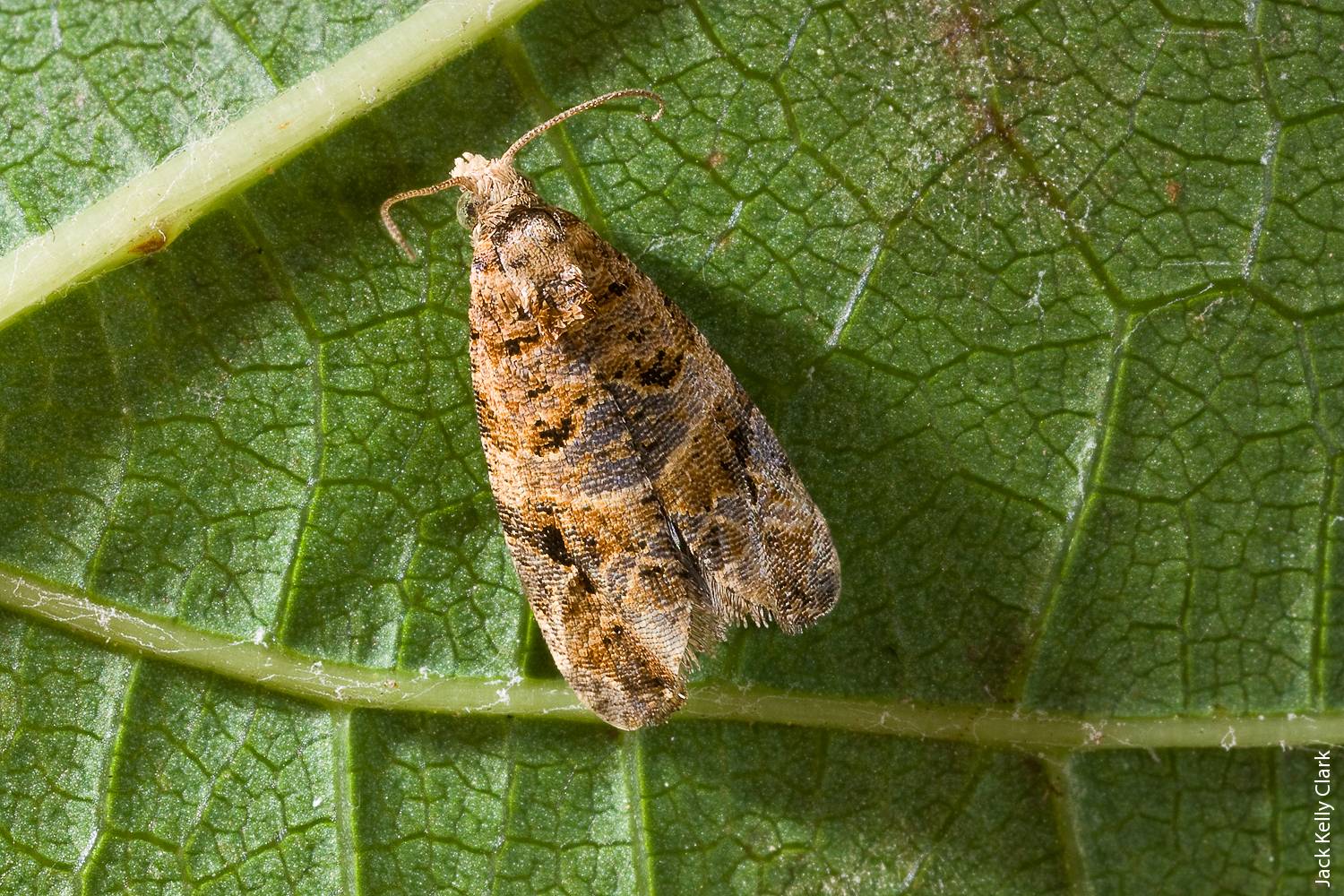
Lobesia:  European Grapevine Moth image by Jack Kelly Clark , University of California Extension
Lobesia: European Grapevine Moth image by Jack Kelly Clark, University of California Extension
So that’s the background, but the drama for our story began in the summer of 2009 in a famous, premium wine grape-growing region called the Napa Valley.  One of the growers there spotted a caterpillar munching away on some of his grapes.  Now there are several kinds of moths that can be pests of California grapes, particularly during their larval stage as caterpillars.  But the grower noticed that this one didn’t look like those familiar types. Being suspicious he sent a picture to a county extension agent – a kind of University employee whose job it is to support the industry with research and advice.  It turned out that was a new kind of moth to California – an alien invader!  Ok, not a space alien, but scary from the perspective of grape farmers.  It was called the European Grapevine Moth or “EVGM.” As its name implies it has been a pest in that continent for a long time.  That name doesn’t sound scary enough for our story so lets use the scientific name, Lobesia botrana.


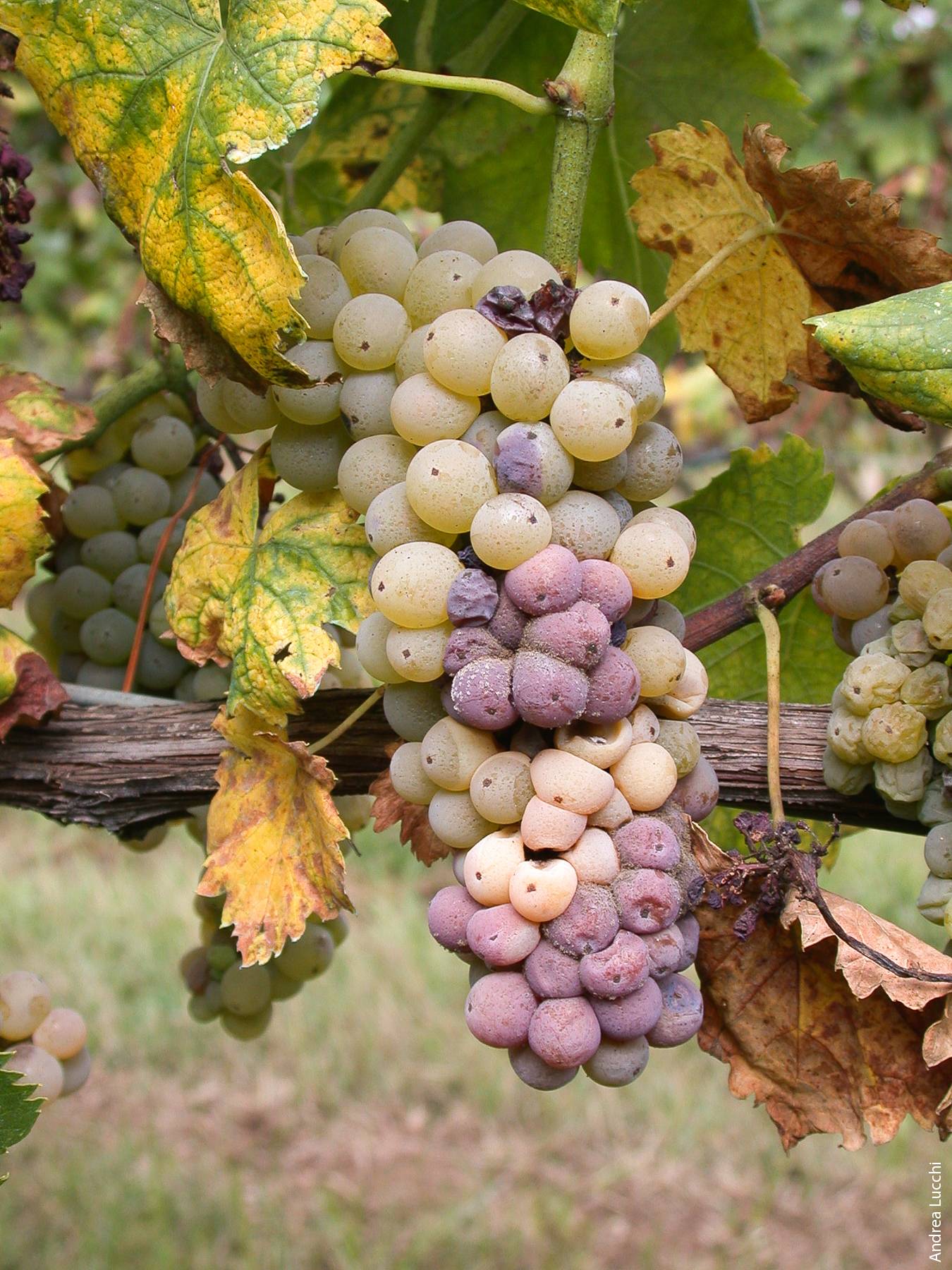
Now the thing is that this wasn’t just another moth.  The caterpillar stage of this bug would do a lot more damage to the grape clusters than the other moth species and that would mean nice things like “frass” or insect poop on the grapes or later the raisins.  To make matters worse, the feeding opens the way for fungi that rot the grapes and that kind of infection can spread from berry to berry throughout the cluster.  This would make it a lot harder for the raisin growers to have a high quality product, it would mean a lot more food waste even all the way to the consumer level for the table grapes.  Moldy grapes definitely don’t make for high quality wine!

Rotting grape image by Andrea Lucchi , University of California
Rotting grape image by Andrea Lucchi, University of California


Now of course there wasn’t an extraterrestrial “Doctor” to lead this campaign, but even Dr. Who drafts a team of regular humans to help defeat the aliens.

In this case the team comprised representatives of the grower communities, university experts and government employees from the relevant state and federal departments. They held an emergency meeting and decided that they wanted to see if they could come up with a way to not only stop the spread of the pest, but if at all possible to completely eradicate it from California.  Eradicate! Doesn’t sound quite as harsh as “exterminate!” but it’s essentially the same idea.


In order to see what they were up against, sixty thousand “Sticky traps” were distributed state wide at a density of 39 per square kilometer in vineyards and 10 per square kilometer in residential areas. In the next 2010 growing season they found 100,000 moths in several California counties.  This was going to be a big challenge!  Only a comprehensive strategy with broad participation would give any hope of winning.  So the team developed a multi-prong strategy:


Those sticky traps continued to be used to monitor progress, but they were careful to use red colored traps because they are much less likely to accidentally trap honeybees.


It was important to find ways to limit further spread of the aliens. The adult moths can fly, but they don’t tend to fly too far as long as they can find the grapes they want. Quarantine rules were set up to prevent fruit, farm equipment, recycled fence or grape posts, or other things that might allow the pest to hitch-hike long distances. It turned out that the moth larvae could survive the stemming and crushing and even pressing of wine grapes – so it was critical not to move around those by-products of the winemaking process.


They also used an approach called “pheromone confusion” that was set up on an area-wide basis where the Lobesia had been found.  This involves putting up emitters of the specific sex hormone for this moth so that the males are getting so many “scent trails” that they rarely actually find a female to actually mate. 


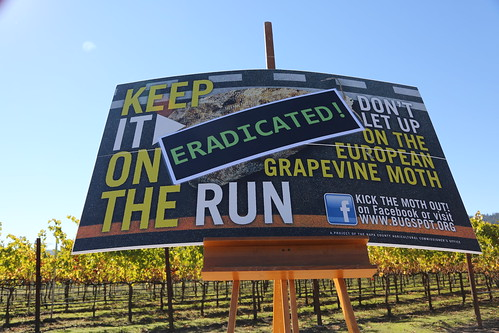
There were lots of outreach programs to get everybody up to speed on the situation and to know their role.  This included grape growers, wineries, and fruit or raisin packers, and pest control advisors. The outreach also had to include on the order of 3,000 homeowners because they also needed to cooperate, especially if they had backyard grapes, as many did. The coordinated task force would help those owners to treat their grapes or remove their fruit so that they didn’t become a reservoir to then fan out into the commercial vineyards. Not only were there public meetings to reach all these groups, there was a Facebook page and a website at www.bugspot.org.


The researchers developed a sophisticated “degree day model” to predict when each of the 3-4 new generations of moths would be coming out so that insecticide sprays could be timed just right, not only to protect the crop, but to prevent the moth numbers from really blowing up as they would if not strategically checked this way.  Almost all of this spraying was done on a voluntary basis at the grower’s own cost.  In Napa and Sonoma in 2012 the growers treated more than 12,000 acres.  The organic growers also sprayed using the insecticide options that are allowed under their rules.  


The combination of the quarantines, the pheromone confusion and the well-timed insecticide sprays achieved what is called an “allee effect” in population biology lingo.  This is when the population size gets down to the point where there are too few of the pests in a given area to successfully mate.


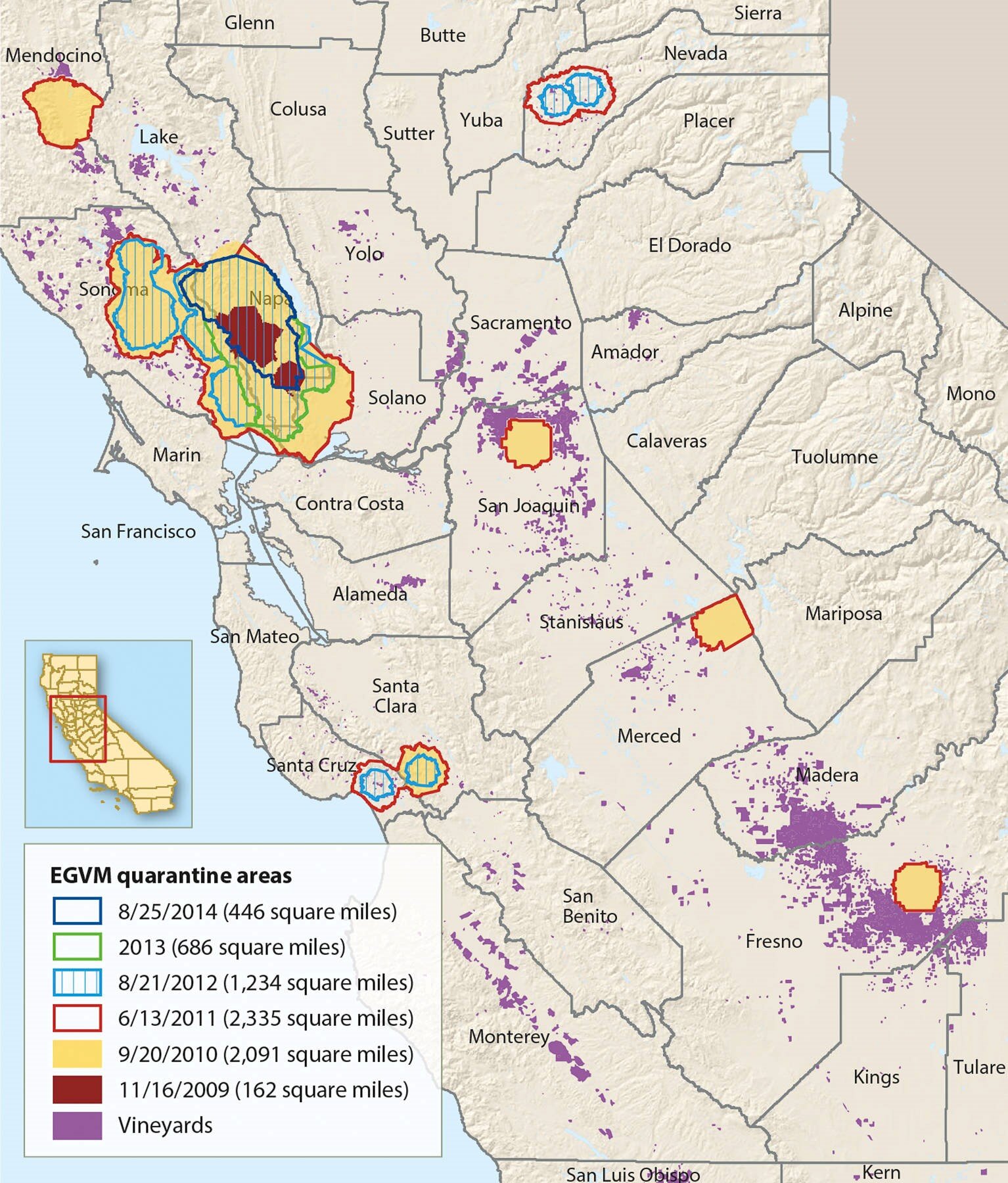
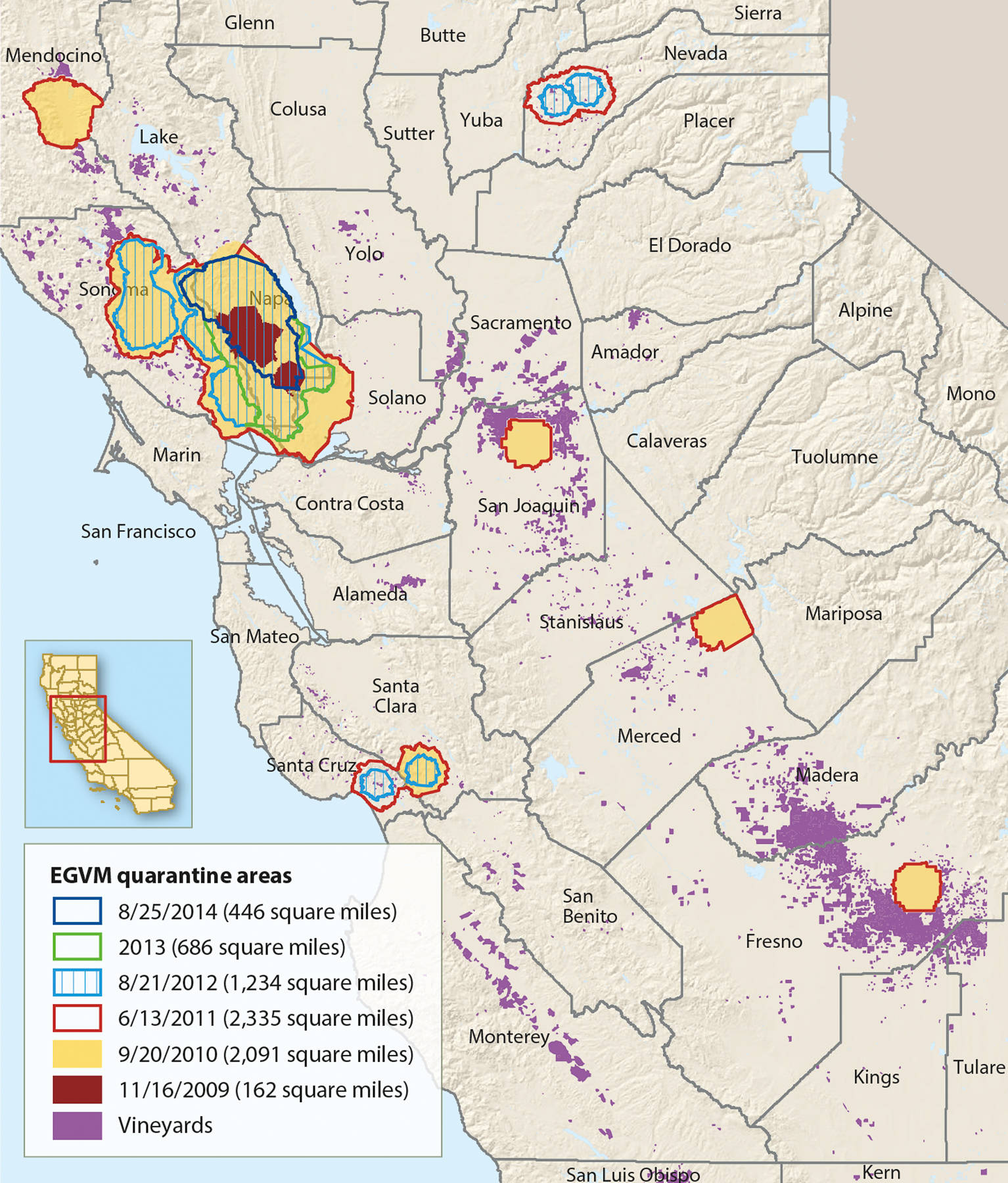
Historical progress  towards eradication of EVGM from California. University of California.
 Historical progress towards eradication of EVGM from California. University of California.

This massive, voluntary, cooperative effort was highly coordinated across the different counties of the state and it began to pay off.  In 2011 there were 2,335 acres quarantined because of the presence of the moth.  By 2014 that number was down to 446 acres.  By 2016 the pest was officially declared to have been eradicated.


Figure 2 Victory Lap! (University of California)
Victory Lap! (University of California)


In the Dr Who shows the Daleks don’t ever seem to manage to “eliminate” humans, but in this story the humans managed to “eliminate” the alien pest. 


There have been some other historical examples where the humans were able to “exterminate” a new insect pest.  Another strategy that was used in some of these battles was the intentional release of sterile males of the pest species so that they so that they would out-compete the wild males trying to breed with the wild females.  This helped when the Mediterranean Fruit Fly came to California several times over the years.   


Another pest eradication success story had to do with a pest of cotton called the Pink Bollworm.  In that case in addition to the release of sterile males, pheromone confusion, area-wide “plow downs” and strategic sprays, the growers also had the opportunity to use lines of “Bt cotton,” genetically engineered to be resistant to the pest. 


Now unfortunately, it will never be possible to have this sort of victory over all the pests of grapes or any crops for that matter.  Still, when growers are only up against a familiar set of pests, they can achieve a sufficient degree of control to protect their livelihood, keep food affordable, and prevent the pest-related quality or food safety problems that would otherwise flow on down to the consumer level.


Thursday, October 3, 2019

A Plant Murder Mystery


(This Blog was originally posted as a Podcast/blog on the POPAgriculture website on 9/5/19)

For some reason, our culture seems to be fascinated by a good murder mystery. I think we all believe that murder is a horrible thing, but we love a story about “good guys” solving a murder case using smarts, careful observation and maybe a little luck. Then we can celebrate when they finally crack the case. “In Cold Blood”, Truman Capote’s book on the 1959 murder of a family in Kansas, played a large role in the growth of the true crime genre. The podcast, Serial, kicked off the most recent true crime renaissance, paving the way for many other true crime podcasts as well as series and documentaries like Netflix’s “Making a Murderer” and HBO’s “The Jinx.” And, who can discount the influence the show “Law & Order” has had, fueling our appetite for stories “ripped from the headlines”?  But what about plants? Can they be murdered? Well there certainly are cases where people “murder” plants in a way that is bad, like deforestation.

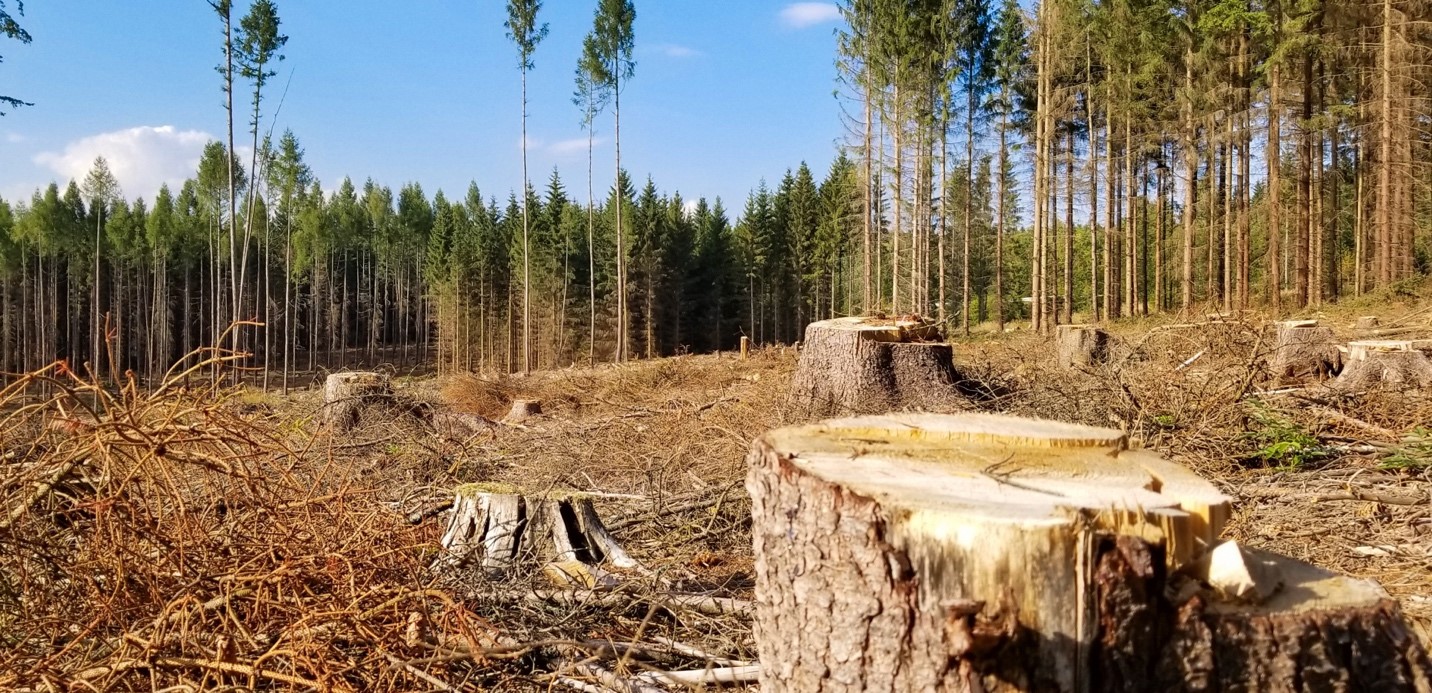
Image of deforestation by  Vera Kratochvil . Actually, this was originally a pest-based mass murder – bark beetle infestation.

Image of deforestation by Vera Kratochvil.  Actually this was originally a pest-based mass murder – bark beetle infestation (purchased image)

But plants are most often murdered by other organisms from nature that we call “pests.”


I was originally trained as a “plant pathologist” and we are the folks who study the diseases of plants. My graduate work was with diseases of grapes, hence my Twitter handle, @grapedoc. Well, plants, including grapes, can sometimes mysteriously die. On today’s  episode, I want to talk about an alarming new disease of grapes that arose in the 19th century. It took a  long time for scientists to track down the culprit. For decades, the “murderer” couldn’t be identified and what was happening in American vineyards really was a case of serial killings whose trail ran cold. A couple of weeks ago, I had a chance to meet another plant pathologist who was one of the key “detectives” who finally “cracked the case” of the mysterious deaths of grapes. He was a player in a great story that I’m happy to be able to share with you today.

When Europeans began to colonize North America 400+ years ago, they brought along the crops they knew how to grow so they could have food – things like wheat, barley, apples, and grapes. Over time, they also adopted several kinds of plants that were unknown in the “Old World” like potatoes, tomatoes, corn and blueberries,  which were also taken back to Europe. Back to the settler’s familiar crops - some did well in the New World, but others didn’t. Wheat did great in the Northern Colonies, but poorly in the South because of a fungal “rust” disease favored by the wetter, warmer weather there. The winters in the North were too cold for one of the European’s favorite crops – grapes. When the settlers tried to grow grapes in the South they would grow for a while, but then mysteriously die after a few years.

The Anaheim vineyards would have been "head-trained" like this rather than the modern system of trellising ( Image from UC Davis ).
The Anaheim vineyards would have been "head-trained" like this rather than the modern system of trellising  (Image from UC Davis)


The Spanish brought the first grapes to the New World. The Friars that set up the first set of missions in what would become California needed the grapes to make wine for communion. The grapes thrived there because of the “Mediterranean” type of climate which was much like that of Spain or Italy or parts of France. For a long time, the grapes did well, but then in the late 1800s they began to mysteriously die, particularly in the Anaheim area. Of course, that is a city today and the home of Disneyland, but it started out as a farming community. There is a newspaper article about these mysterious vine deaths that you can see online from “The San Francisco Call” from December of 1894 about what had come to be called “Anaheim” disease. It describes how over a period of 10 years the strange malady had ravaged over 20,000 acres of grapes and nothing the growers did seemed to help. Anaheim has also been the scene for some human disease incidents, like the 2017 outbreak of Legionnaire’s disease that was linked to those who visited Disneyland. But the 1894 article was quoting a talk given by the head of the State Viticultural Commission, E.C. Biehowsky, in which he was celebrating the fact that the disease seemed to be abating although no one knew why. But the case of vine deaths remained unsolved and there were other outbreaks that killed vines in the 1930s and 1940s. This eventually drove the grape industry out of Southern California and into other parts of the state.

Back in 1892, California’s first professional plant pathologist, Newton B. Pierce, tried to unravel the mystery of this disease. He suspected that it was caused by a bacterium but he wasn’t able to culture any and use them to replicate the disease – the protocol called “Koch’s Postulates” that is the required way to provide proof of what kills or sickens something in the “courtroom” of science. Others ended up naming this malady “Pierce’s Disease.” That’s not a great outcome. I hope they never name some deadly plant disease after me!

The next “detective” on the case was Bill Hewitt at the University of California, Davis. He showed that the disease could be transmitted from one vine to another by grafting and that, in nature, the disease was spread by little sap sucking bugs called blue-green sharpshooters. This fit the M.O. of a virus and that would also explain why you couldn’t culture it. Suspect #2, a virus. Then, a competing set of detectives in Florida showed that the disease could be suppressed a bit with the antibiotic tetracycline. That made them suspect it was a mycoplasma – effectively the third “suspect” in this case. One of those researchers at the University of Florida is Don Hopkins and he is the actor from this story that I recently met. The Florida group’s suspicion about a mycoplasma was shared by a grapevine virus expert at Davis, named Austin Goheen, because he showed that heat could also suppress the disease.

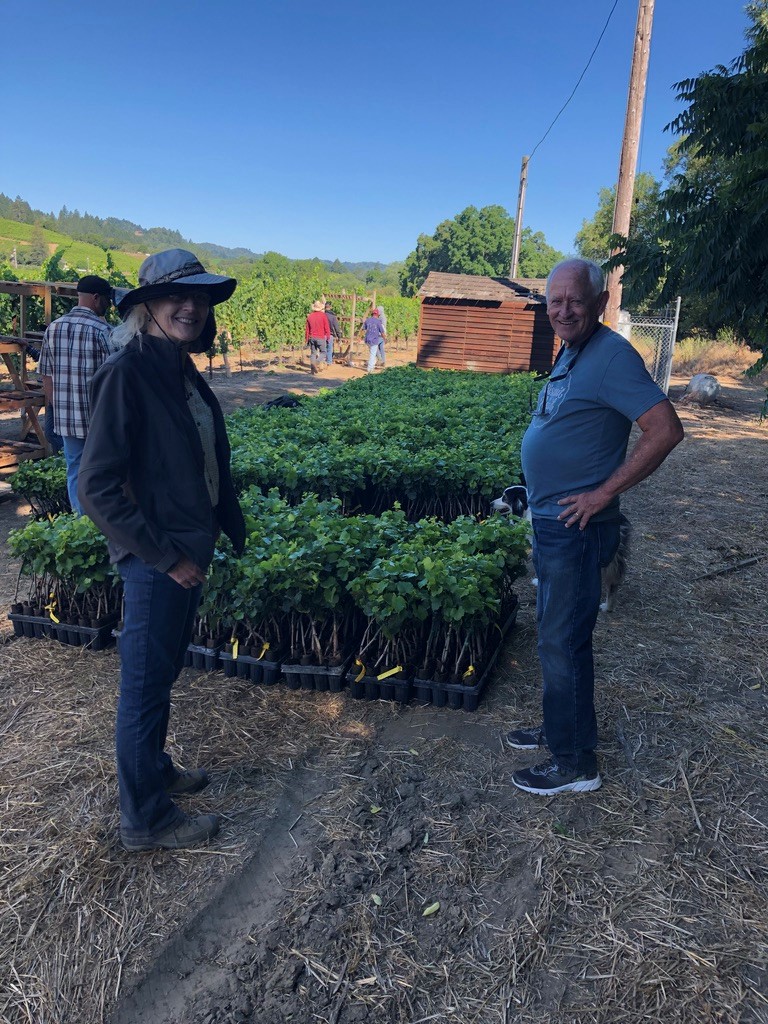
Dr. Don Hopkins from the University of Florida (right) and Sonoma County grape farm advisor Rhonda Smith (left). We spent two days planting the young grapevines pictured here for a Pierce's Disease biocontrol trial this summer.
Dr. Don Hopkins from the University of Florida (right) and Sonoma County grape farm advisor Rhonda Smith (left).  We spent two days planting the young grapevines pictured here for a Pierce's Disease biocontrol trial this summer
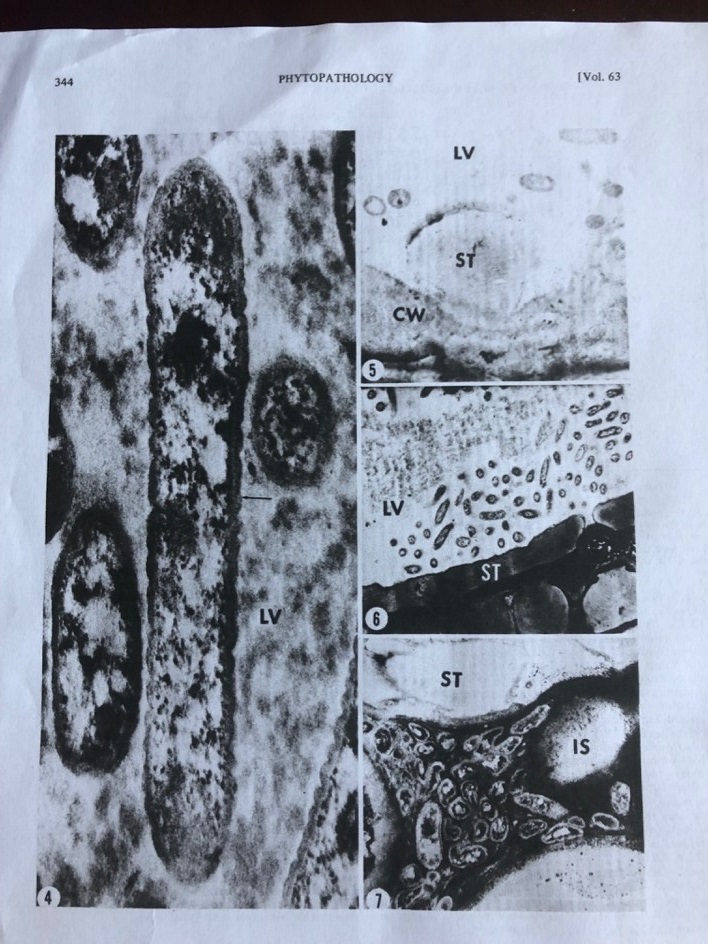
Now, the classic meme for a detective show is someone with a magnifying glass. That might be enough enlargement power for someone working on a homicide case, but the detectives in the plant murder investigation needed something a lot more powerful. Fortunately, there was a powerful new investigative tool that was becoming more available called an electron microscope. The earliest work on this tool was in the early 1930s and it became more practical with work at the University of Toronto in 1938. With this new tool, scientists were able to see far smaller things than had been possible with even the best light microscopes. A researcher at Davis in the 1960s and early 70s named S.K. Lowe assisted Goheen and another scientist named George Nyland, using her skill with the department’s new electron microscope. With it, they peered inside the grapevine to see if they could catch the perpetrator of Pierce’s disease in the act. Inside the plant’s xylem cells – essentially its water plumbing system - they saw strange, elongated blobs which they decided to call “Rickettsia-like organisms,” the fourth suspect in the case. They also described it as a “fastidious bacterium” because it was apparently too picky to let people grow it on normal culture media. Goheen, Nyland, and Lowe got a paper describing this new finding accepted for publication in a journal called Phytopathology on October 3, 1972, but it didn’t actually publish until March of 1973.
The image of the "culprit" taken with an electron microscope and published in the journal Phytopathology. 
The image of the "culprit" taken with an electron microscope and published in the journal Phytopathology
Simultaneously, the Florida team, Hopkins and Mollenhauer, published similar findings in the January 1973 issue of the prestigious journal, “Science,” also based on what they had been able to see using an electron microscope. They also classified the suspect as a “Rickettsia-like bacterium.” For both investigations, those electron microscope images were “the smoking gun.” Even though these two sets of “detectives” on opposite sides of the country fingered the same culprit, there was actually somewhat of a rivalry. In a sense, the Florida team “won” because their verdict came out in print two months earlier! (Remember this was long before the internet.)

By the time I got to that UC Davis plant pathology department in the spring of 1977, George Nyland had retired, and my new major professor was the replacement for Bill Hewitt. Austin Goheen was still there but would retire within two years. Since I was in the “Grape Lab,” I certainly heard the UC Davis version of the tale of hunting down the culprit for Pierce’s disease, and they were still just calling it a Rickettsia-like bacterium.

Then in 1978, another team of scientists/detectives at a different campus of the University of California in Berkeley finally caught the culprit red handed by coming up with a recipe for the medium which would finally coax this picky perpetrator to grow in their petri plates. These new players were Mike Davis, Alex Davis, and Sherman Thompson. They found the same organism also caused almond leaf Scorch disease. So, the “suspect” was now “identified”, but we still didn’t know exactly what to call it.

It wasn’t until 1987 that yet another team of six “detectives” used the rapidly advancing tools of biotechnology and DNA/RNA sequencing to “fingerprint” the grape murdering bacteria, and they declared it to be a brand new genus, which they gave the clever name Xylella fastidiosa:  Xylella for the Xylem of the plant in which it lives, and fastidiosa in acknowledgement of how challenging it had been to learn to grow it outside of its unfortunate victims. This diverse team of scientists came from labs at the USDA, Rutgers, the Weyerhaeuser company, the University of Illinois, and the Centers for Disease Control, or CDC. Add that to the three other institutions in this story and you get a sense for how hard it was to fully understand this disease that had been killing grapes since those early days in Anaheim, or the even earlier attempts to grow grapes in the American Southeast, which turns out to be where the bad guys came from in the first place. In the text version of this episode on popagriculture.com, you can also see a map of where this bad bacterium can now be found around the world – mostly in the Americas, but a bit in Europe and Asia.
he tragic death of an old olive grove, "murdered" by Xylella (Sjor,  Wikimedia commons ). 
It turns out that Xylella isn’t just guilty of killing grapes. It can cause problems for oaks, citrus, and the ornamental oleander which is widely used for planting in the median strips of California highways. Just recently, a new and unique strain of Xylella showed up in Italy where it “murdered” trees in venerable old olive groves. I’ve provided a link to a “National Geographic” article about this – it’s so sad to think about some of those ancient trees going down. It’s a threat to olives in Spain and Greece as well.


The tragic death of an old olive grove, "murdered" by Xylella (Sjor, Wikimedia commons)


aerial over Sonoma.jpg
A picture I took this summer while flying into Sonoma County. 
Note the missing (murdered) vines by the river
But just knowing the true cause of Pierce’s disease didn’t make the problem go away. You can’t exactly go out and arrest bacteria that live, as it turns out, in all sorts of plants – cultivated and wild. What the grape industry had learned was that the bug that spreads this malady – the blue-green sharpshooter - only likes to live and feed on the plants that tend to grow along rivers in what are called “riparian habitats.” The sharpshooters venture out into vineyards from time to time, so the typical pattern is you see dying vines in the parts of vineyards closest to the Napa River in Napa county, or the Russian River in Sonoma county.

There is an aerial photo above that I recently took while flying into Sonoma. You see that there are more missing (killed) vines on the side of a vineyard along the river but not as many near the reservoirs which don’t have a true “riparian” zone. No one would consider taking out that natural vegetation in the riparian zone although there can be state funds to selectively take out certain invasive plants which are actually even worse than the native ones in terms of being a hiding place for the bacterium and its vector.


Grape growers in these regions mostly just deal with a certain degree of vine death because these are regions with a great reputation for wine quality.

But there is a twist in our murder mystery! In 1997, there was a dramatic die-off of grapevines in a relatively new wine grape growing region called the Temecula Valley. This is in southern California, but further inland than that original problem zone in Anaheim. Temecula Valley had not had any problems with Pierce’s disease because it’s pretty much a desert and does not have those “riparian” zones that the blue-green sharpshooter accomplice likes. But a few years earlier, probably because of some eggs on nursery stock imported to California from the southeastern U.S., a new invasive insect had arrived called the glassy winged sharpshooter.

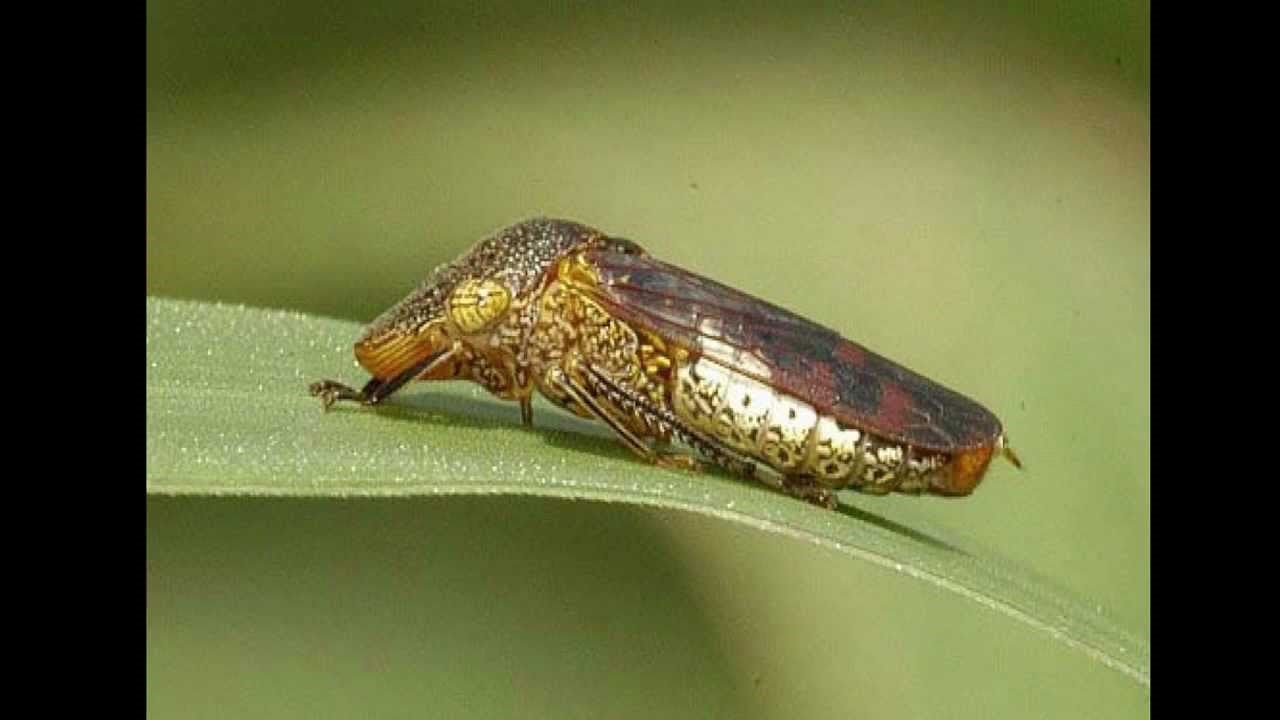
The "accomplice" (Glassywinged Sharpshooter, image from the  California Center for Invasive Species Research ).
The "accomplice" (Glassywinged Sharpshooter, image from 

Now our identified murderous Xylella had an accomplice that isn’t at all picky about what plants it feeds on. It’s happy on citrus and there was a lot of that in Temecula intermixed with the vineyards. Some of the wineries lost 80 to 90% of their vines in the first few years of this attack and it seemed like the end of grapes, not just in Temecula, but potentially throughout the state if that new insect would spread.

The grape industry and its supporting government agencies quickly mobilized to fight this dangerous new duo. They found an insecticide that could be given to the roots of the citrus and grapes through the drip irrigation system. It would then move up and protect the plant from the sharpshooters. That put the brakes on the epidemic and the vineyards of Temecula have been successfully replanted and protected. I visited grape growers in that area in July and they have almost no dead vines and a thriving tourist industry for wine tasting.

The state also put in place very rigorous inspections and quarantines of all nursery stock moving north to prevent the sort of hitchhiking that got the glassy wing here in the first place. Grape growers all around the state chip in for a state run monitoring and targeted insecticide program that has, thus far, been able to prevent that new accomplice from moving to the rest of the state. It’s working so far, but no one in the industry is complacent.

The search is on for additional tools to fight both the insect and the bacterium. It would take another whole podcast to just list the research efforts, but briefly they involve ideas ranging from conventional breeding, to biotech traits, to live biocontrol agents, to insect predators and parasites, to various natural products, to a new sprayable chemical bactericide. I’m tracking these now and am even participating in one effort as part of my “day job” as a technology consultant. I can’t think of anything I’d find more satisfying than to see the grape industry find a robust set of strategies to shut down that murderous bacterium once and for all!

Good general reference on PD including new Olive issues: https://www.cabi.org/isc/datasheet/57195

Big article Hopkins and Purcell 2002 – talks about host range, geographic …