Showing posts with label Food Security. Show all posts

Wednesday, March 22, 2017

New GM Technology Allows Crops To Just Say No To Dangerous Toxins

Contaminated maize in Africa - Image from International Institute of Tropical Agriculture

(This article originally appeared on Forbes on 3/21/17)

There has been a breakthrough on a way to reduce the risk of a major form of cancer in the developing world. It involves corn genetically modified to "just say no" to the production of a carcinogenic toxin in its grain.

Have you heard of Aflatoxin? It is a major risk factor for cancer in the developing world.  Aflatoxin is a natural chemical produced by a fungus. It is a highly toxic and is a very potent carcinogen in animal studies. Those of us in the developed world are fortunate in that a number of safeguards keep aflatoxin out of our animal feed and human food supplies. Unfortunately, in the developing world, people are not so well protected. In those regions aflatoxin contaminated foods are responsible for many poisonings, and high cancer rates. Researchers in Arizona have recently published a paper about a biotech crop breakthrough that could dramatically improve that situation.


Aflatoxins are chemicals produced by certain fungi that infect food crops (Aspergillus flavus, Aspergillus parasiticus). The biggest developing world risks are with maize (corn), and groundnuts (peanuts) - staple, subsistence crops in parts of Africa and Asia. When insect feeding damages crops and/or through drought stress, they are most susceptible to infection by these fungi. The infections can continue to develop after harvest, particularly under less than ideal storage conditions.

Maize (corn) in Africa (Image by Kate Holt/AusAID)


In an article published in the prestigious journal, Science Advances, five scientists from public institutions in Arizona described how they genetically engineered corn to prevent its contamination by aflatoxin. For this article I spoke with Dr. Monica Schmidt of the University of Arizona. Schmidt’s team engineered the corn to make three small RNA molecules designed to specifically bind to parts of a particular RNA produced by the fungus. These small RNAs made in the kernel cells are able to move from the corn into the invading fungus. Once there, they trigger a mechanism in the fungus cells that blocks the production of a key enzyme required by Aspergillus to make aflatoxins. Because this approach involves three separate bits of targeting RNA, it is extremely unlikely that the fungus could mutate in a way to get around this blockage. The corn plants modified this way are effectively protected from contamination with aflatoxin. This kind of corn could give developing world consumers a much safer food supply.

This work was funded by the Gates Foundation, which also funds work to develop corn that is resistant to insect damage and drought. In combination with the aflatoxin protection this constitutes an ideal integrated solution for that critical crop. This is also a proof of concept for taking a similar approach with peanuts. The intention is to make this technology freely available for breeding into the local crop varieties that are best adapted to the regions in question.

What about the developed world? It would actually make a lot of sense to add this technology to the diverse toolset that we already use to keep aflatoxin out of our corn and peanuts. There are also other crops that could benefit from another protection strategy from aflatoxin – notably tree nuts like almonds, pistachios, walnuts and pecans. Aflatoxin can also be an issue in cottonseed that is used as an animal feed. The same biotech strategy may well work with other fungal toxins that can be an issue in other crops.
The world’s consumers can derive great health benefits from the further development of this technology.  This is definitely one to track and to encourage.

You are welcome to comment here and/or to email me at savage.sd@gmail.com


Saturday, January 21, 2017

Whole Foods Wants To Sell You Slower-Growing Chicken. That Is Probably A Bad Idea


(This post originally appeared on Forbes on 1/20/17)

One challenge of being a modern food consumer is knowing what to believe or not believe in terms of food production narratives. There is a new campaign claiming that going back to older, slower growing chicken breeds is the right thing to do. There are some good reasons to reject that idea.

Most Americans enjoy eating chicken. On average we each consume about 90 pounds per year, a three-fold increase compared to per capita consumption in 1960. Chicken producers have kept up with this increasing demand even as our population has also increased. What was once a luxury food has become a very affordable option. Chicken remains an economically attractive choice for consumers, in large part because of increases in the production efficiency of modern chickens. Particularly in the last century, chicken farmers have consistently mated their best roosters with their best hens and steadily shifted their flock genetics towards more and more efficiency. Today, chickens are the most efficient of our meat animals in terms of how much grain it takes to produce each pound of final product. That also means more efficiency in terms of water and land use. Overall, this history is a good example of increasing sustainability.

While this progress has been a positive for consumers and the environment, there are some advocates saying that we should go back to using earlier, slower growing breeds of chickens. They claim that the rapid growth compromises the welfare of the birds and that slower growing chickens are a more ethical choice. The slow growth argument is that the weight gain of the chicken has outstripped its bone development so that the chicken becomes physically compromised, at least in the case of the birds kept around longer as breeding stock. In a recent article by Dan Charles for NPR, that concern seemed to be supported by William Muir, an independent animal science expert from Purdue University. I wrote to Dr. Muir and he said he had been misquoted. He and other industry experts say that chicken breeding has been simultaneously focused on weight and bone strength. 

By several objective measurements, modern chickens seem to be better off. Mortality rates are down substantially. The houses in which chicken are raised have better climate control and the flocks are protected from disease by vaccination.   Antibiotics were once used to improve gut health but that practice has been phased out. As of 2017 there is no longer any feeding of dual-use, animal/human antibiotics for growth promotion in chicken. This website has a helpful video about how chickens are raised.

The upscale grocery retailer, Whole Foods, is asking its suppliers to make the switch back to slower growing breeds. Some animal rights groups are putting similar pressure on the companies that supply chicken to restaurants. Is there really a conflict between sustainability and animal welfare when it comes to our most popular meat?

As consumers we would be wise to be skeptical about the assertion that fast growth is bad for the birds. Not everything you hear about chickens is true. For instance many consumers have been convinced that they should buy chicken labeled as not having added hormones even though no chickens are given hormones and haven’t since the 1950s.

Some of the ramifications of shifting back to slower growing chickens
Last week the National Chicken Council released a detailed report about what a change to slow-growing birds would mean in terms of resource-use and production costs. I pulled out some of the statistics that were most compelling to me as a crop scientist. In the hypothetical case that one third of the chicken industry switched back to slower growing birds, it would substantially reduce the overall supply of chicken for only a 14 day change in the growing cycle of the birds. The drop in feed-use-efficiency would mean that 33.5 billion more pounds of feed would need to be devoted to chicken production which would represent 670,000 tractor trailers full of grain. Currently each acre of grain (corn/soy) can feed 344 birds. The same amount will only feed 224 of the slow growing birds. That would translate into 7.6 million acres of farmland needed to support a 1/3 conversion. There are also ramifications for water use, the amount of manure produced (28.5B pounds), and of course the cost ($9B at the producer level and much more at the consumer level).

NCC is encouraging the foodservice and retail industries to fully consider all the economic and environmental ramifications of a potential change in chicken genetics. They are also supportive of research to objectively evaluate questions about animal welfare and health as effected by growth rate.

It is likely that some food industry players could profit from the creation of another up-sell category for meat. However it is appropriate to ask whether that is indeed a responsible path to take. Consumers have good reason to think this one through before going along with this marketing campaign.

You are welcome to comment here and/or to email me at savage.sd@gmail.com


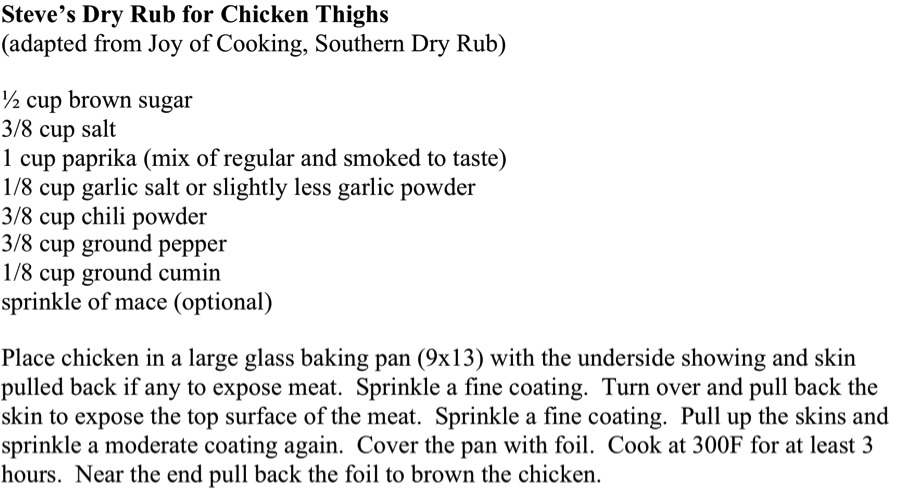
(Just to show that I take my chicken seriously, here is my favorite recipe for home made, dry rub chicken)


Friday, June 19, 2015

One Agricultural Scientist's Concerns About The Future Of The Food Supply


(originally posted on Forbes 6/17/15)

I’m generally optimistic about the ability of the world’s farmers to continue to feed the growing population, and also to satisfy the increased food demand of the growing middle class in previously poor countries.  That hope is based on the amazing track record of innovation by farmers and their technological supporters that I have witnessed over the past four decades.  I do, however, have some significant concerns about trends and factors that may compromise the farming enterprise over the next critical decades.  My “concerns” fall into four major categories, and I will unpack each of them in subsequent posts. I will briefly describe the full set of concerns in this article because, while no single issue is insurmountable, there are potential negative synergies between them.

I. Changing physical/biological realities for farming

Farming has always been a challenging and risky endeavor.  It is becoming even more so in an age of climate change and with even more frequent introduction of invasive pests.  These combined issues are a dire threat to the livelihoods of smallholder coffee farmers facing worsening rust issues in Central America.  It’s a harsh reality for California farmers facing a lack of water because of low snowpack in the Sierras.  It’s a depressing reality for Florida citrus growers  or Italian olive growers  facing new pests killing their trees and possibly their industries.  These challenges play out differently in diverse geographies and for various crops, but these enhanced uncertainties are of major concern – particularly in light of the categories described below.
Dead olive trees in Italy, killed by a newly introduced disease with no short-term or even obvious long term cure

II. Three societal trends compromising the future of the farming enterprise:

1. The level of public investment in agricultural research continues to decline even though the pay-off of such spending has been clearly documented.  Private investment is strong, as is some from philanthropies, but it is best complimented by public activity.

2. There is also a two-fold “brain-drain” happening in key fields of expertise in agricultural sciences (e.g. agronomy, soil science, soil microbiology, plant pathology, entomology, nematology, etc). A combination of baby-boomer retirements and a lack of young people entering these disciplines is driving this shortage. We are losing a huge resource in terms of expertise and experience with those retirements (I'm talking here of far to many of my peers). Finding qualified applicants for jobs that support farming has become extremely difficult for employers. This is a precarious situation as we face the highest levels of food demand in history.

3. Increasingly, the ownership of farmland is in the hands of uninvolved, “absentee” owners (often the remote descendants of past farming families) who lack understanding of the implications of their leasing practices. Many important, sustainable farming practices pay for themselves, but only over the medium to long term. Common, annual cash rent leases don’t give farmers the appropriate rewards for running their complex, long-term operations.
A Map of Leased Land in the US

III. Uncertainties about the on-going “Social License” of agriculture

Farming, like any enterprise, depends on a certain level of societal trust and non-interference with its activities.  The term “social license” is used to characterize this relationship. This is threatened, because the farming community is a tiny minority in society, whose reputation can be driven, not by its own actions, but by outside voices.  Farming today is the subject of widespread disinformation from elements within the press, social media, the entertainment industry and certain not-for profit groups.  It is also grossly mischaracterized by a burgeoning, fear-for-profit sector in food marketing.  The phenomenon of “parallel science” also distorts and confuses even that potential voice of reason.  This climate of disinformation also leads to declining public trust in the regulatory system and to erosion of the scientific independence of those regulators.  Objective data demonstrates great progress in the health and environmental profiles of modern farming.  That is not the story that consumers are hearing in the Internet age.  Farmer-bloggers and others do their best to counter this phenomenon, but they are seriously out-gunned.

IV. Control of the Food Supply

Only a small fraction of the possible applications of plant biotechnology have ever been implemented on a commercial or humanitarian level.  I’m careful not to say that biotech, or any other singular technology, will “feed the world.”  Only farmers could ever do that. But biotechnology is one category in the “tool box” that can be particularly helpful for farmers for certain crop-specific issues.  It could also have interesting consumer benefits.  Only a tiny fraction of that potential has been realized because the “food supply” has been quite effectively “controlled” by the opponents of “GMO crops.”  In my next post I will describe how that control has been achieved. What has been largely ignored is the fact that where farmers have had the option to grow biotech crops (on about 8% of global cropland), they have found them to be extremely useful and adopt them at high rates.  This has been true in both the developed and developing world. When the “control of the food supply” works against the interests of farmers, it compromises their ability to meet the modern food supply challenges.

Why I'm Concerned

As I watch the combination of rising demand, changing climate, and new pest problems with low investment, declining expertise and technology suppression, my optimism about the food supply is tempered.  As I see the farming community being falsely represented, less fairly regulated, and ignored I worry about their incentive to forge on or stay in that critical but difficult business.  When I see rich world agendas being imposed on the world’s poor as form of green imperialism, I worry about those people at most at risk if we fail in the modern food challenge.
I would be interested to know what others think about these issues and would greatly appreciate hearing any ideas about solutions.  I’d like to combine them with other ideas that I have heard when I unpack these concerns in subsequent posts.

As always you are welcome to comment here and/or to email me at savage.sd@gmail.com

Saturday, August 11, 2012

This Is Your Food Supply On Climate Change

OK, I'm going to go out on a limb and say that I think that this year's climate extremes are linked to human-caused climate change.  We might not really have the definitive answer on whether that is true for 20 years, but I would like nothing better than to be proven wrong about the linkage I'm making today.  From a global food supply perspective, the effects of weather on 2012 food production is problematic no matter what its cause.  As bad as it seems, it might just be a "shot over the bow" relative to what me might expect in the future. The unfilled corn cob pictured above is a relatively decent example of what the US corn crop is yielding this year.

How Hot Is It?

This isn't just about low rainfall.  There is a recent graph about temperature extremes on the NOAA (National Oceanic and Atmospheric Agency) site that is striking. The 2012 difference from average is off the chart!


When it is both hot and dry, our dominant, rain-fed crops suffer the most.

It Isn't Just A US Drought

Yes, we have a massive drought in the US unlike anything we have seen for decades.  But there are also drought issues with wheat in Russia and excessive rain issues with crops in Western Europe that could ruin some of their harvest with mycotoxin contamination.  Ironically, the last season in Australia was better than many for their wheat crop which means that there is less low quality wheat going into the feed market that has been important for Chinese and other Asian meat production in recent years.
What ever this year's weather represents in a climate change context, it has been problematic for the global food supply.  The FAO (UN Food and Agricultural Organization) tracks the prices for various foods in international trade and generates a "Food Price Index" each month.  I've been blogging about this for a couple of years, but the new data released on August 9th is disturbing - particularly the data for cereals (wheat, rice, corn, soybeans,etc).  See the graph below


The red line is for the period 2010-12 and in the 30th month of that cycle we are seeing a 17% increase in one month - a steeper climb that was even seen in the 2007-9 price spike (green line).  This rise was seen even before the full magnitude of the US drought was known.  I shudder to think what the index will show next month.  The 2007/8 spike has been linked to a great deal of political insecurity and even credited as a driver of the "Arab Spring."  Hold on to your hats to see what this new price spike will mean.
Of course the impact of these high food trading prices depends on how dependent a country is on imports and how much of family income is spent on food.  There is an excellent new site from the Economist which compares countries around the world in terms of their food security and food spend.
I'll say it again.  This certainly looks like the sort of climate extreme and related food supply impacts that we would expect from climate change.  I both hope to be around in 20 years and to be proven wrong about my belief that "this is our global food supply on climate change."

You are welcome to comment here and/or to email me a sdsavage@sprynet.com
Drought damaged corn image from grifray