Showing posts with label EPA. Show all posts

Saturday, March 23, 2019

Do You Really Need to Worry About Pesticides on Your Kale?


-->
 
Bundle of Kale (Wikimedia commons)

Last week the Environmental Working Group (EWG) published its annual “Dirty Dozen List” and highlighted Kale near the top of it’s list of foods with “pesticide residue contamination.” They want you to buy your Kale as Organic.  EWG claims to base that recommendation on data from the USDA’s Pesticide Data Program (PDP), but a closer look at the actual data suggests a far different conclusion – that the Kale in our food supply is quite safe and that there is not the big difference between organic and conventional that they imply.

Since EWG gets much of its funding from large organic marketers, it is not surprising that their recommendation is to buy organic, but the 2017 PDP testing included 67 samples that were labeled as USDA organic (13% of the total for Kale).  Many of those organic samples had detectable residues representing 31 different chemicals, only one of which is approved for use on organic crops (Spinosad).


Now the levels at which chemicals were detected on the organic were very low and of no health concern based on the very conservative “tolerances” set by the EPA through its extensive risk assessment process.  However, the same can be said for the 455 conventional Kale samples tested the same year of.  The residues we are talking about here are hundreds to thousands of times below the relevant tolerance (see graph below).


In theory there wouldn’t be any synthetic residues on organic, but the USDA’s certification rule allows for “inadvertent” presence of synthetics at 5% or less of the EPA tolerance. (There is a separate USDA-Organic compliance testing program that looks for residues, and in that case the 5% rule applies).  98.9% of the 2017 PDP detections for organic Kale samples would meet that standard, but so do 98.1% of the residues on conventional samples.  Not so different, eh? In the graph above, only the red part of each bar would be a technical violation of the organic rules and none of the Kale detections for either conventional or organic exceeded the tolerance. Note that neither category is actually “dirty” based on a rational, scientific assessment.

Now, there were about three times as many residues/sample found on the conventional Kale, but the USDA does not even test for a great many of the pesticides that are approved for and regularly used on organic.  This would include “natural products” such as mineral-based materials (e.g. sulfur or copper compounds), petroleum oils, plant extracts, and biologicals).  Those sorts of products make up a substantial part of what gets applied to Kale. Thus, pesticides which are not part of the PDP testing make up 65% of the total pounds of crop protection agents applied to kale and 44% of the treatment acres (see graph below from the most recent available year of California use data).  Approval for organic is entirely based on what is considered to be “natural” and the USDA is quite clear that the classification is not about relative safety.


The acreage of Organic Kale has been increasing over the last 15 years and with it the use of the organic-allowed pesticides.  (See the example of sulfur use on Kale as linked to organic acreage in the graph below).


If the USDA tested for residues the natural product pesticides, the number of “detections” for organic samples would certainly increase. But as with the synthetics, the results would most likely indicate that this is a perfectly safe vegetable to consume whether or not it is organic.  Bottom line, the wisest thing for consumers to do is to ignore the fear-mongering of the EWG and simply enjoy a healthy diet including lots of this and other fruits and vegetables.

Thursday, March 9, 2017

The EPA Deserves Some Respect


Do you remember how comedian Rodney Dangerfield always used to say: “I can’t get no respect!” Lately that is how it seems for environmental regulatory agencies like the EPA.  I feel as though we need to defend the very idea of sound regulation against three intensifying challenges:
·      threats of defunding or arbitrary rollbacks coming from some on the populist-right
·      a denial of the progress that has been made by some on the eco-left, and
·      a severe under-appreciation of our legacy of environmental protection by American society as a whole

I certainly can’t defend or critique all regulation, but as an agricultural scientist I have observed four decades of a reasonably function federal and state level regulation of pesticides and other crop protection agents.  I’m not saying that system is perfect, but I have witnessed how it has greatly advanced the health and environmental profile of this sector.  I’ve watched the sifting out of problematic practices in response to increasingly sophisticated scientific understanding.  I’ve also watched how this system has provided a framework that that encouraged the private investment and innovation needed to bring farmers better and safer tools with which to protect their crops and thus our food supply.

I speak here strictly as an individual not trying to speak for any company or organization. I have had a long career in this sector.  I’ve never had a regulatory compliance role as such, but I’ve been involved in the process of finding and seeking regulatory guidance and/or approval for products based on synthetic chemicals, natural product-based chemicals, and live biological control agents. I’ve interacted with dozens of employees of the EPA, the California Department of Pesticide Regulation and other state-level regulators. Yes, my industry connections and experience gives me a certain bias, but it also gives me some practical and historical perspective from which to share.

I believe that our goal should be to refine our regulatory processes, not to dismantle, dismiss or fail to appreciate them. To pursue that refinement goal I believe that there are four principles of sound regulation that can be learned from this example.  Good things can happen when we have:

1.     A system that is consistently guided by science and adjusted as scientific understanding evolves
2.     A system where regulatory decision making is reasonably free from political pressures and agendas
3.     A system which focuses on managing the risk of harm, rather than on based on hazard out of the context of real-world exposure
4.     A system which maintains perspective on benefit/cost trade-offs
5.     A system which is sufficiently predictable and timely so that it remains rational to make a substantial and continuing private-sector investment in the development of innovative new solutions


A few years ago I gathered historical information about the pesticide use on what is still one of my favorite crops – California wine grapes. The chart below shows the trend for one measure of toxicity for this crop, but it is indicative of trends in other crops and with other measures of impact.  Pesticides have clearly changed for the better, both in terms of what they provide for the farmers and in terms of their safety profile. 

Category IV "practically non-toxic", III "slightly toxic", II "moderately toxic", I "highly toxic".  This is for acute oral toxicity.


This progress was possible because of massive and sustained private investment. That, in turn, was possible because the industry could count on a fairly rational regulatory process.  This was in no way a cozy relationship, but it was functional. The nature of the EPA regulations has definitely evolved over the decades as guided by developments in environmental science and toxicology, but the process is sufficiently rational to encourage further investment to find the newer, better tools.  This is an excellent example of successful innovation under an intense, but highly functional regulatory regime. 

I wish I was fully optimistic about this process moving forward, but I have some deep concerns regarding the public perception of the EPA. First of all, very few consumers, voters, reporters or food thought leaders seem to have any appreciation for the progress made over nearly five decades of EPA pesticide regulation. Instead, I see assumptions or expressed views about crop pesticides that are a distorted caricature that does not even fit with “the bad old days” prior to regulation. The positive historical impact of the EPA case has been inadequately articulated. This leaves the agency vulnerable to the populist urge to discard or severely restrict its role. The under-appreciation of marked progress made with EPA oversight provides fertile ground for unethical marketers who exploit fear of pesticides for economic gain. Similarly, an under-appreciated EPA helps to empower activists such as those in Hawaii who are exploiting fear to drive a politicized over-ride of agricultural regulation. 

I am also concerned about the role of science in EPA pesticide regulation going forward. Primarily in Europe, but increasingly in the US, we see junk science and activist manipulation diminishing the scientific integrity of the regulatory process.  Problematic examples include questions about pollinator health or the IARC cancer hazard statements. In these and other situations we need a trusted, robust, independent EPA that confers with a robust, independent academic science community, as it has historically. We need an EPA that appropriately considers the risk/reward profile of its actions and which appreciates the eco-modernist perspective. What we don’t need is an EPA distracted by endless activist lawsuits or facing political uncertainty about its future. We need an EPA that gets a little respect.


-->

Tuesday, March 7, 2017

Organic Might Not Mean What You Think It Means

(This post originally appeared on Forbes 3/6/17)

Organic might not mean what you think it means.  Recent data generated as part of the USDA’s Pesticide Data Program (PDP) shows that there are detectable, low level pesticide residues on organic fruits and vegetables. This isn't surprising information.  It echoes results from previous PDP testing and with more comprehensive testing of organic samples in 2001-11 by the USDA and 2011-13 by the Canadian Food Inspection Agency. What is interesting is that while the incidence of residue detection is somewhat lower for organic, the very low levels of chemicals found are quite similar to the low levels detected on conventional samples. The 2015 PDP study found residues of 68 different pesticides, pesticide metabolites, or plant growth regulators on organic fruits and vegetables.


Red organophosphates, Blue carbamates, Green organochlorines from historical use


For 37% of these chemicals the average residue on organic samples was actually higher than the averages on conventional, but still very small.
What really matters is that the levels detected for both kinds of produce are below the “tolerances” that are set by the EPA and those tolerances already reflect a generous safety margin.  

So, what these data really tell us is this:
“Yes. Skilled analytical chemists can detect tiny amounts of synthetic and natural pesticide residues on organic and conventional produce. In both cases the level that are found are below to well below any threshold of concern. Our regulatory system is working. Those who grow our food are well trained and are following the rules designed to both enable crop production and protect the public. Enjoy your safe, healthy, delicious options!”

Background on the PDP


Each year the USDA gathers and analyzes around ten thousand samples from the mainstream US food supply – mainly fruits and vegetables. In the sampling process, USDA ends up including some items labeled as USDA Organic (349 samples in 2015, 4% of the total). USDA labs then look at all the samples for residues of crop protection chemicals using extremely sensitive analytical methods.

USDA provides both brief and detailed summaries of this information, but I appreciate the fact that the raw data is transparently available to the public so that I can look through it myself (it is bit challenging because there is a two million+ row main table, a 10 thousand row sample table, and 18 reference tables). I looked in detail at all the pesticide detections and also looked at the testing results for produce samples that were being sold with the organic claim.

What Was Found?


As with the overwhelming majority of samples, the residues detected on the organic items are at levels below the conservative “tolerances” that are set by the EPA. Yes, residues are present. No, they are not a safety problem. However, the presence of residues does conflict with what many consumers have been led to believe about the difference between organic and conventional.

Many people think that organic means “no pesticides.” That is simply not true. Organic farmers can and do use a range of allowed pesticides because they too have to deal with pests. The list of organic-approved pesticides is not based on safety criteria but rather on whether or not they can be considered “natural.” Again, in spite of much misleading marketing, “natural” does not automatically mean safe. In fact the USDA which is in charge of organic certification specifically states on its website that “our regulations do not address food safety or nutrition.”

As with all pesticides and other crop protection products, it is the EPA which assesses which pesticides can be used safely, and within what constraints.

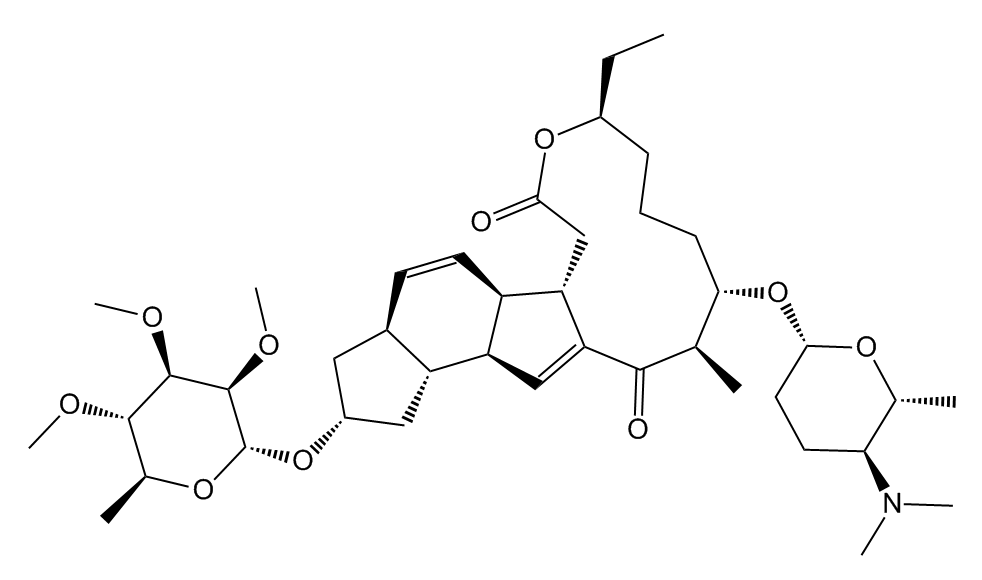
So what sorts of residues are found on the organic samples? The most common detection is of an insecticide called spinosad. That is an effective control for a variety of caterpillar pests and is produced through a microbial fermentation process, thus allowing it to qualify for use in organic (see chemical structure of one of the spinosyns below). Just to be clear, the spinosad products are produced by the Dow chemical company.

Chemical structure of a spinosan (Image from Cappacio)
Conventional farmers also make good use of this and other natural products. Spinosad is really the only natural product pesticide that is detected in the USDA’s monitoring program. Other widely used products like sulfur, petroleum distillates, copper salts and microbial products can’t be monitored using the same, highly sensitive and cost-effective tools that allow the USDA to generate the more than two million test results they generate each year. If specific tests were conducted for those natural products, the number of residues detected per organic sample would probably be much larger – but it wouldn’t really change the overall conclusion that these foods are safe to enjoy.


Other than spinosad, the remaining 80.2% of residues detected on organic are of “synthetic” chemicals.

Graph by author

While very few of the synthetic materials used in agriculture today are intrinsically very toxic to humans, they are theoretically not supposed to be present on organic because they are not on the list of approved, natural options.

There is however a rule in the organic certification system that any residue present at 5% or less of the USDA tolerance will be considered “unintentional” and thus not a reason to deny organic certification. 62.1% of the 2015 organic detections met that criterion, but interestingly so do 74.6% of the detections on non-organic samples from the US and 70.1% of the detections from imported, non-organic samples. Not so different.

Another 15.6% of residues detected on organic technically violate the organic rules by being over 5% of EPA tolerance, but such residues are still fully safe based on EPA criteria. That same safety criterion applied to 23.0% and 25.2% of conventional US and imported samples respectively. For both organic and conventional there are a few detected residues of products that don’t have a specific, assigned tolerance for the crop in question. These are generally very low-level detections, so while they represent technical violations they are not of real concern and once again, similar for organic and conventional (average “no tolerance” detection for organic 23.7 parts/billion, average for conventional imports 19.8 ppb, and average for US conventional 17.2 ppb).

To reiterate, what this transparent public database tells us is that our food supply is safe from the perspective of pesticide residues. This means that our regulatory system is working and that thousands of farmers in the US and elsewhere are doing a great job of managing pest damage while still protecting our health. The data also tells us that there are some striking similarities between organic and conventional when it comes to residues. What the data also tells us is that as consumers we should reject some of the misleading marketing and advocacy efforts of certain irresponsible elements of the organic industry. Instead of giving in to those fear-based campaigns we should feel the freedom to choose healthy and delicious produce using important criteria like freshness, flavor, quality and affordability.

There is a site you can use to visualize the PDP data http://www.cropaudit.org/

You are welcome to comment here and/or to email me at savage.sd@gmail.com


Tuesday, December 13, 2016

How Can Pesticides Be Safe?

Many people may find it difficult to imagine how a pesticide could ever be safe. To understand how that is possible, it is helpful to make the comparison with something more familiar: electricity.
It is hard to envision modern life without electricity. As much as we enjoy and need this source of energy, it involves some hazards. Electricity can, and sometimes does, cause injury or death.  Yet overall, we think of using electricity as a reasonably safe aspect of our lives.
Safety can’t be precisely defined. What we perceive as safe is something where the benefits more than offset the minimal risks. We can enjoy electricity’s benefits with little risk through two main strategies: 1) using low-hazard forms of electricity and 2) keeping ourselves from being exposed to hazardous forms of electricity.
the-safe-use-of-electricity
The Low-Hazard Approach
Increasingly, we power the devices central to our lifestyles with forms of electricity that are practically non-hazardous. The prime examples would be our cell phones, Bluetooth devices, or portable music players that run on low-voltage, direct current electricity which is nearly incapable of causing us harm.  That same, low-hazard approach plays an important role in pesticide safety.
In the middle of the last century, a number of the early pesticides in use were chemicals that were quite toxic to mammals, and thus to humans. The U.S. began to seriously address the issue with the establishment of the U.S. Environmental Protection Agency (EPA) in 1970. Soon, the truly dangerous pesticides were removed from the market or their use was greatly restricted.
Since then, billions of dollars have been spent on the discovery, testing and regulatory review of new, far less toxic pesticide options. In the charts below, I’ve examined the toxicity of crop protection materials that have been used through looking at historical U.S. Department of Agriculture (USDA) data on Washington State apples and California pesticide reporting data from all crops in 2013. In these charts, the toxicity is based on feeding studies with rats or mice, which is used as an indicator of potential toxicity to humans. Other measures of toxicity have similar trends.
oral-toxicity
The EPA has four toxicity categories to classify the acute hazards of pesticide products. For use in apple orchards, the data show that pesticides from EPA Category I, Highly Toxic, were never more than 10% of the total pesticides used, and that their use has steadily declined. These would be pesticides as toxic as the nicotine that is sold for e-cigarettes. Only 0.2% of the pesticides applied to California crops in 2013 were in this category.
oral-toxicity2

EPA Category II, Moderately Toxic, includes materials with toxicity in the same range as the capsaicin in hot peppers or the caffeine in coffee – familiar and even sought-after natural chemicals in our diets. That category represents very limited use on apples today, and only 18% of what growers applied in California apple orchards in 2013.
The pesticide use category that has grown is termed Slightly Toxic (EPA Category III). Toxicity for crop protection materials in this category is in the same range as the citric acid in a lemon or the vanillin in a vanilla bean.
The largest category of pesticides applied to apples and other crops today is Practically Non-Toxic for mammalian consumption (EPA Category IV). Comparing this to our use of electricity, we can see that low hazard is a major strategy through which we minimize pesticide risk.
To understand how something that is designed to kill or otherwise control a pest could be non-hazardous, consider the example of chocolate which has a flavor ingredient that we humans love but which can be toxic to our pet dogs. Chemicals can have different effects on different species. Scientists use the terms specificity and mode of action to describe how chemicals have their specific effects. With modern pesticides, the mode of action is normally the inhibition of some specific enzyme that is important to the viability of the pest. If the enzyme is inhibited by the pesticide, the pest might stop eating, stop growing and/or die.
That enzyme often isn’t one that even exists in humans and other animals ourselves or in other groups of organisms unlike the pest. A modern insecticide usually only affects enzymes that are found in insects or even a few kinds of insects. A modern herbicide might only inhibit an enzyme that is needed for the growth of plants. A modern fungicide inhibits an enzyme in a pathway of enzymes that is found in certain fungi. While all of these products should still be handled with a reasonable degree of caution, they are, like the electricity that powers our cell phones, low hazard and thus low risk. We can feel safe about their use.
Limiting Exposure Risk When There Is a Hazard
We still need the more hazardous forms of electricity (such as the 120 volt alternating current) for needs like lighting, heat, air conditioning etc. To minimize risk, we’ve developed safe guards such as systems of insulated wiring, childproof plugs, circuit breakers and GFCI outlets to keep us from being exposed to that hazard. Where we need 220 volt service, we have even more ways to avoid exposure. To be connected to the grid we need the extremely hazardous, high-voltage electricity coming to us from wherever it is generated. The high-power transmission lines are designed to make it unlikely that anyone will be exposed to that extremely hazardous form of electricity.
Some pesticides that we need to manage certain pests represent a possible hazard to mammals, like humans, or sometimes to other non-target organisms like birds, fish amphibians or aquatic invertebrates. The safe use of these pesticides is all about limiting exposure. For all pesticides used in agriculture, anyone who is directly involved in the mixing or application of the chemical must follow specific requirements regarding protective clothing and equipment. For low-hazard materials, that might just be gloves, closed shoes and a dust mask. For something that could be a significant human hazard, those restrictions would include a respirator and a protective whole-body TYVEC™ suit.
Restrictions can also dictate how soon after an application anyone can re-enter a treated field (re-entry interval or REI). For low-hazard pesticides, that time period can be a few hours or less. For more hazardous pesticides, the REI can be a number of days. For pesticides that are hazardous to fish or other aquatic organisms, restrictions mandate how close applicators can apply them to waterways. Similarly, for pesticides that are hazardous to bees or other pollinators, restrictions control when applicators can apply them relative to bloom times and/or times of the day when bees and other pollinators are working.
For all pesticides, the EPA conducts an extensive risk assessment and uses that information to set up a detailed set of restrictions designed to prevent the existence of any residues of concern to consumers by the time the crop is harvested. The details of this system are discussed in another post titled, Do I Need to be Concerned about Pesticide Residues on and in My Food?
The moral of this story: just like electricity, pesticides can be used in a way that meets our need for clean, productive farming while giving us a comfortable and functional level of safety.

Wednesday, March 2, 2016

Ten Thousand New Reasons Not To Worry About Pesticide Residues

(Originally posted on Forbes 3/1/16)

Each year, the farmers around the world who produce our food (fruits, vegetables, grains) get the equivalent of a “grade” on a giant “group project.”   For 2014 they got another A+ as they have for many years.  The “test” entails thousands of food samples, which the USDA collects from normal US food channels and then scrutinizes for pesticide residues using extremely sensitive laboratory testing methods. They are checking for any detectable residues (41% of samples have none) and whether any of the detectable residues exceed the conservative “tolerances” set by the EPA (99.6% of the samples met that exacting standard). This means that our regulatory/farming system is working extremely well! Farmers are able to produce crops without the inefficiency and quality issues associated with excessive pest damage, and consumers are able to safely enjoy what they grow. The official conclusion from the USDA is “These Pesticide Data Program data show that, overall, pesticide residues found on foods tested are at levels below the tolerances established by the U.S. Environmental Protection Agency (EPA) and pose no safety concern.”


Chemical pesticides are only one part of the pest control regime, but an important one. The chemical pesticides in use today are predominantly low in mammalian toxicity, but for all pesticides the EPA sets detailed rules for how they can be used (e.g. maximum rates, periods of time before harvest…). These are designed to ensure that any residues that remain at the consumer level are below a “tolerance” based on a rigorous, multi-factorial risk assessment by the EPA. The tolerance is generally 100 times less than a dose that could cause any ill effect.  The allowed residues are also lower than the levels of natural pesticidal compounds that many crops make to defend themselves.

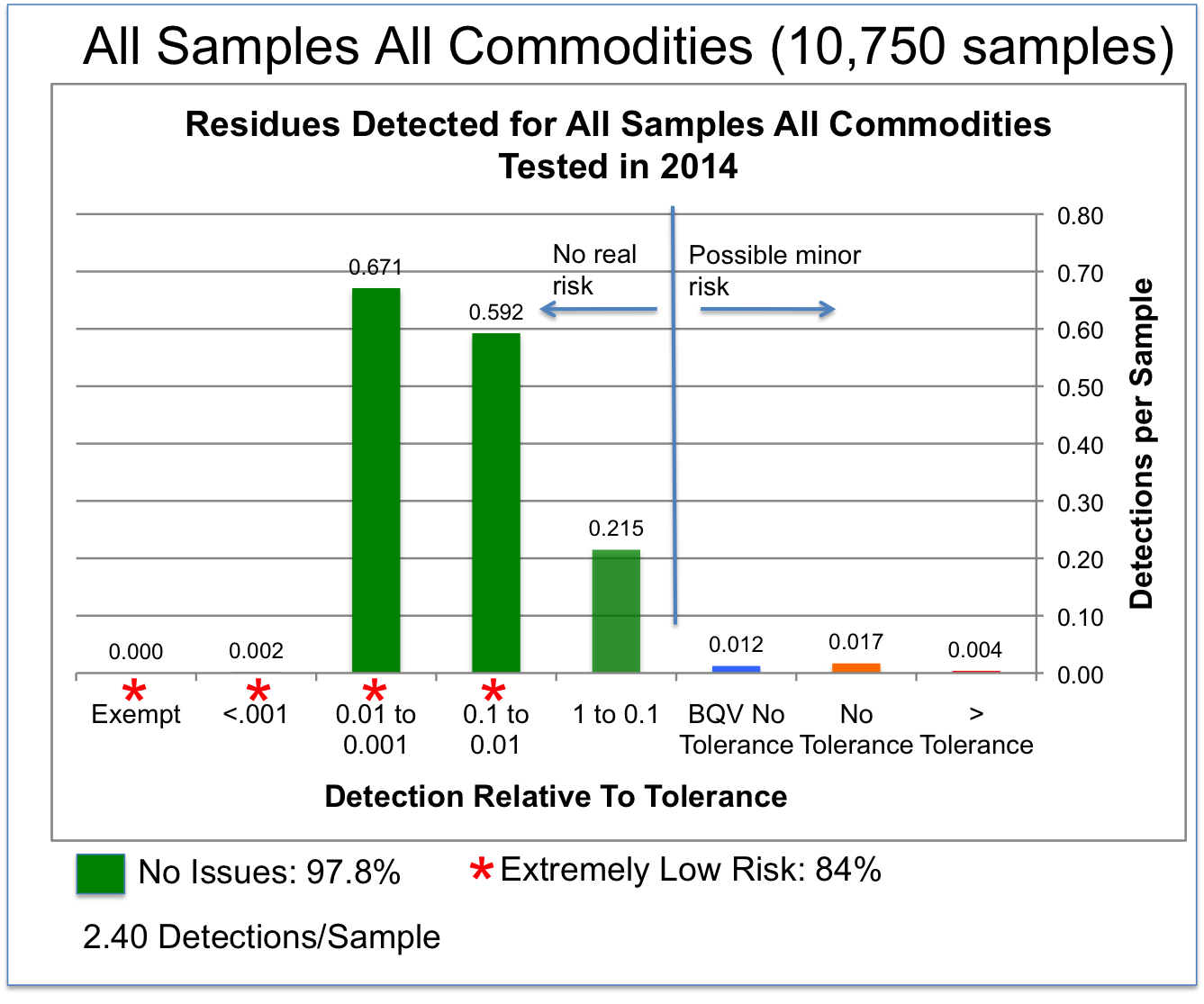
The 2014 USDA “test” is called the Pesticide Detection Program or PDP, and it has been conducted every year since 1991. For 2014 tests were done on 10,750 samples including 21 types of fruits or vegetables, two grains, two types of infant formula and salmon. The scientists detected a total of 22,890 specific pesticide residues of which 98.5% were below tolerance or at such low levels they couldn’t even be properly quantified (see table below).


I appreciate the fact that the USDA makes this data available and transparent. It allows us to see that not only are most of the residues below tolerance, a great many of them are more than 10, 100 or even 1,000 times lower than the tolerance (see column chart below - all to the left of the center bar are no-issue detections, but 84% are far below).


There are some minor differences between crops. In the two charts below, the light green bars show how many of the detections in a given crop were below tolerance, and the dark green bars show what percent were 10 or more times lower than the tolerance. The samples of infant formula had, happily, either no detections (dairy-based formula) or a few detections that were between 1000 and 5000 times lower than the very low tolerance (soy-base formula, 7 of 527 samples). Oats and rice also had few detections and those at very low levels.

Unfortunately, the very transparency which documents the safety of our food is grossly misused by an organic industry-supported organization called the Environmental Working Group. EWG conducts its own “analysis” of the data in which they completely ignore how the detections differ from one another and how they relate to the tolerances. Their choice to represent as “dirty” any residue, no matter how low or non-toxic, conveniently ignores the fact that similar pesticide residues are also regularly detected on the organic options that they promote. Hopefully they will refrain from such irresponsible fear-mongering this year.
So, at the risk of being like a parent who only focuses on an A- on a report card of all A+s, I looked in detail at the 1.5% of residues were of any potential concern. For the few detections that exceeded tolerance, most were only marginally higher and thus of very minor concern.  There were some residues detected for which there was not a tolerance for that specific crop, but in most of those cases the levels were lower than the tolerances for other crops.  The EPA also tests for some old, long-banned pesticides notorious for their environmental persistence. There were 18 detections of such materials, including three from organic samples.  Of those 18, 17 were at extremely low levels and only one was very significant (0.46ppm monocrotophos in a squash sample from Mexico).  All in all, I could only find 11 residue examples of moderate concern, which is an amazingly small number (0.045%).  I have posted a much more detailed analysis on Scribd.  If anyone is interested I'll be happy to email you that full summary.
So once again, the take-home message is that we have another 10,000+ reasons to confidentially enjoy our American food supply.  My congratulations to those who produce it for us.

Tuesday, September 22, 2015

A Closer Look At Organic Pesticides In California


I've posted an article on Forbes taking a general look at the role of organic-approved classes of pesticides in California.  The take-home points are that pesticide actives that are approved for use in organic made up 55% of the total crop use in 2013 and that those are used by both organic and conventional growers.  I also take a look at the relative toxicity (simple acute ingestion toxicity) and there is a similar range for the organic and synthetic options.  None of this is surprising because what determines whether a pesticide can be "organic" is whether it is "natural", and that is not a safety-based criterion.  The safe use of all pesticides is the responsibility of the EPA and similar regulators around the world.


In this post I'd like to delve in more detail into what these widely used organic pesticides are and why they are used by all sorts of growers.

Major Categories of Organic-Approved Pesticides


In the first graph in this post I've divided the organic-approved materials into Mineral-based, Oil-Based, Natural Products and Live Biologicals.  I'll talk about each category below.

Mineral-Based Pesticides


The mineral-based pesticides that are approved for organic include sulfur, lime-sulfur, and various forms of copper. Together these materials comprise 34% of the pounds used but only 12% of the area treated. That is because these are relatively high use-rate materials (~2 to 25 pounds/acre).

Sulfur has been used as a pesticide since ancient times. While it is essentially non-toxic by ingestion, as someone who has worked long hours in treated vineyards, I can tell you that it is quite irritating to the eyes and skin. Sulfur controls powdery mildew fungi and suppresses spider mites, but has to be reapplied every 7-10 days. It works by sublimation (direct transition from solid to gas) so it is ineffective if it is cold and can burn the crop if it is very hot. It is converted into reactive sulfur compounds in the humid boundary layer of a leaf or berry.  Conventional growers have alternatives that need only be applied at ounces/acre every 14-21 days, but continue to use some sulfur in their programs as a way to manage resistance to the newer materials (see chart below for the trend in sulfur use on premium California grapes).

Conventional grape growers today use about 1/3 as much sulfur because they have other options

The next big mineral-based material is lime sulfur.  It is used for some dormant season sprays, so its “moderately toxic” status (EPA Class II) is not an issue for crop residues.  The remaining organic mineral pesticides are the copper-based fungicides which were discovered in the late 1800s and actually saved the European grape industry when a downy mildew pathogen was introduced from the New World. Some of the copper products are Class II in terms of oral toxicity, can be persistent, and are toxic to aquatic invertebrates, but with appropriate care for where they are used, they are considered safe . Again, conventional growers have lower rate, longer interval, more effective options, but use some copper for resistance management. Coppers are also one of the few options for the control of certain bacterial diseases and for algae control in rice fields.

Petroleum Oil-based Products


An interesting organic-approved category is a collection of oils derived from petroleum (mineral oil, paraffinic oils, petroleum distillates…). These too are relatively old products used at high rates, but they are effective on mites, aphids, whiteflies, scale insects and also powdery mildews. These are also EPA Category IV – “essentially non-toxic” to mammals by ingestion.  Again, they are also used by conventional growers along with other more modern options.

JMS Stylet Oil is a major organic brand in this category

Natural Products

Spinosyn-A - some seriously fancy chemistry (image via Klever)

About 2% of the acre-treatments on California crops were with various “natural products” which are chemicals that are made by plants or from fermentations of various microbes (thus qualifying them for organic). Nature is indeed a remarkable chemist, but that is not a guarantee of safety. Some of the most toxic chemicals known are from nature. The safe use of these materials is based on the same, elaborate risk assessment that agencies like the EPA conducts for all pesticides. The most widely used natural product is the plant hormone gibberellin (540,000 acre treatments). The next biggest product (309,000 acres) is Spinosad which was introduced by Dow Agrosciences. It comes from fermentation of an actinomycete. It’s a remarkably complex chemical, but very low in mammalian toxicity (Category IV) and quite effective against all sorts of caterpillars and hard to control insects like leaf miners. Unlike the mineral or oil-based pesticides, it can move inside of the treated plant to protect newly emerging leaves.  Lately it has become available to homeowners as “Captain Jack’s Dead Bug Brew” which is a sort of silly name, but definitely something I use in my garden.

The number 6 natural product (22,500 acres treated) is a relatively recently developed, plant-based natural product that comes from a plant called Epazote or American Wormseed. The small, California company that commercialized it was purchased by Bayer Chemical Company. They have since introduced a product in Europe which is made of a mixture of the same four terpene chemicals that occur in the plant extract. That sort of product often generates much debate in the organic community about whether it is still natural, but the chemicals are the same. In any case this product is effective against various insects including thrips which are difficult to control. That is why it will be increasingly used by both organic and conventional growers.

Thrips cause these feeding scars you often see on snap peas or snow peas
The smallest category of organic-approved products are the biological control agents. The most used and famous of these are various strains of the bacterium Bacillus thuringiensis, or “Bt.” These bacteria make a protein that is selectively toxic only in the guts of certain insects (e.g some work only on caterpillars, some only on beetles and some only on mosquitoes). Together, 10 Bt-based products were applied to 320,000 acres. Some crops have been genetically engineered to express these same Bt proteins, but those would not qualify for organic. Sweet corn has been modified this way, but the sweet corn growers have been asked by their retail store customers not to use the "GMO" varieties. Instead they must make at least six more sprays a season than they would need to if they could use a Bt variety. That is a shame.

The "natural" pesticides that are approved for organic also have an important role in conventional agriculture.  They are not qualitatively less toxic than synthetics, but then virtually all the pesticides used today are only moderately toxic at most and most commonly non-toxic in the classic sense. These and the modern synthetic pesticides play an important role in the efficient use of the land, water, fuel and labor that it takes to produce food. 

You are welcome to comment here and/or to email me at savage.sd@gmail.com