Showing posts with label #Organic. Show all posts

Wednesday, November 25, 2020

The European Union's Wine Grape Quandary


The European Union has recently published a lengthy "Farm to Fork Strategy" which sets out ambitious goals for its agricultural sector. One part of the agenda is to reduce the use of pesticides either by restricting the way they can be used or in many cases by not authorizing their continued use when those particular chemicals come up for periodic review by regulators. Often these restrictions are at odds with the rigorous safety assessments that have been made by many regulatory bodies around the world including the US EPA. Another part of the agenda is to encourage the expansion of Organic farming. There are several reasons why this plan will cause serious complications for European farmers, and since the EU is a major importer of food, feed and fiber crops, the restrictions that it applies to various grape pesticides will also be a problem for farmers around the world who export their crops to the EU market.


Many crops will be affected by this agenda, but one interesting case-study is what this push will mean for the prominent and highly regarded wine grape industry in the EU.  Wine grapes only represent around 3% of EU farmland, but around 20% of total EU pesticide use. There are several reasons for this relatively intensive use of crop protection products.  For one thing wine grapes are a very high value crop so growers can afford to use more products to optimize the yield and quality of their fruit. But there are also important historical and genetic reasons why certain pests represent a particular challenge for the European grape industry. 


With most crops, breeding is an important strategy to help with pest problems, notably when that involves tapping into the genetic diversity available in various wild relatives of the cultivated crop. With wine grapes the breeding option has essentially been "off-the-table" because of the long tradition which has identified very specific Old World grape varieties of the species Vitis vinifera which have been found to provide the highest quality for the weather and soil conditions of each growing region or "appellation." The long-term history and tradition of growing specific grape cultivars in each region is often called "terroir" and this is not anything the industry wants to change because it needs to meet consumer expectations and marketing narratives about wine quality.


Interestingly in the 1870s there was a dramatic change to the genetics of European grapes.  A root feeding insect called Phylloxera was inadvertently transported to Europe from North America. The various wild species of grapes that evolved alongside Phylloxera are fairly resistant to the damage from that specific insect pest. (The most familiar example of this kind of grape is a species called Vitis labrusca which consumers know as Concord Grapes because that is the kind of grape used to make non-alcoholic grapes juices such as the famous brand - Welches). The native American grapes are not considered to be that good for making high quality wines, but some hybrids between the two species are grown for wine in the Northern US in areas that are too cold for Vitis vinifera.  The Vitis vinifera grapes of Europe evolved without the challenge from Phylloxera so once the pest crossed the Atlantic the vineyards were highly susceptible to its damage and began a steep decline.  The only way the industry was able to be saved was by grafting the vinifera cultivars onto "American Rootstocks."  Grafting is a horticultural technique that has been practiced for centuries, but it was only with great reluctance that the European growers took that step. 


A grafted grapevine, image from Washington State University Extension


Around the world today virtually all wine grapes are grown on these "American" rootstocks because they can provide protection from soil-borne pests while allowing the traditional varieties to achieve the desired fruit qualities that made them so desirable. Rootstocks are used for almost all perennial crops and also for high value vegetable crops like fresh market tomatoes.


There are also two serious foliar diseases that also made the jump from North America to Europe in the 1800s. The first was a disease called Powdery Mildew and it causes loss of yield and quality as it grows on the exterior of the leaves and fruit.  Vitis vinifera is highly susceptible to this disease.


Grape Powdery Mildew infection of a developing grape cluster. Photo by Laura Jones/Univ. California, Davis


The solution that was found is probably the oldest known pesticide, elemental Sulfur.  This "natural" mineral product was found to control the disease but only if the grapes were "dusted" with something like 10 pounds/acre of sulfur every 7 to 10 days for much of the season until the fruit begins to ripen (a stage called veraison in grape-speak).  Sulfur is not very toxic to eat or drink, but it is an eye and skin irritant that can make it quite unpleasant to work in a vineyard. There is also some evidence that as with other dusts, sulfur can increase the risk of asthma among the children who live near the places were dust products are applied. California has recently restricted the use of sulfur and other dusts near populated areas. "Wettable" forms of sulfur can still be used without the respiratory problem and that is still a part of integrated pest management systems for grapes.  However; most modern grape growers use sulfur more sparingly because newer and more effective "synthetic fungicides" have been developed which require far smaller doses at longer intervals and which are in the EPA toxicity class IV described as "essentially non-toxic" by ingestion. I remember a time in 1978 during my second season being out in California vineyards for my graduate research that I was amazed to smell a beautiful floral aroma during the grape bloom period - something I had not experienced the season before. It was because I was in a block treated with the first example of these new fungicide options instead of the normal odiferous and irritating sulfur. I have a podcast about that event.  Grape growers who choose to grow for the organic market are not allowed to use these more modern tools and must therefore depend on high use-rate options like sulfur and something called "petroleum distillates" (think mineral oil for the later).  Thus, this is just one example of how the EU Field to Fork strategy embodies conflicting goals if it wants to reduce pesticide use and the push for more organic production.


Grape Downy Mildew sporulating on the bottom of a leaf. Photo by Mark Longstroth, Michigan State Univ. Extension

There was another "intruder" fungus pest that originated on North American grapes and then caused even more severe problems for the European industry in the 1870s.  It is called downy mildew.  The solution that was ultimately found to this disaster was another very early pesticide. It was discovered by a French botanist named Pierre Millarday who noticed a particular vineyard along a roadside that stood out by exhibiting much less damage from the new disease. He learned that the grower had applied copper sulfate combined with lime as a way to make the fruit look unappealing so that people passing by would stop helping themselves to his grapes (you can see an image of this blue coating in this article in Wine Spectator).  


That "natural" pesticide became known as the Bordeaux mix and it saved the grape industry.  It was also a much-needed solution for a related disease on potatoes that had cause the famous Irish Potato Famine in the same era.  Various copper-based products do work against these pests and many are approved for use in organic production, but unfortunately they are quite toxic to aquatic organisms and are persistent in the environment since the mineral copper is copper and it isn't going to break down to innocuous components the way that many other natural or synthetic chemicals do over time. After years of use, copper fungicides build up in vineyard soils and can become toxic to grape roots. Many European organic growers have had to abandon their organic status because of these soil issues.  Copper fungicides also require high use-rates (4-6 pounds/acre) and frequent applications because the copper is easily washed off by rain. 


Once again, many low toxicity, highly effective and environmentally safe synthetic fungicides that have been developed to fight downy mildew, but those options are not allowed to be used by Organic growers. European regulators are not fans of these copper fungicides, but their politicians have made exemptions for their own grape growers while at the same time setting up barriers to more benign products that have met rigorous standards in other countries.  


Organic growers also have limited options for the control of mold fungi that can infect the grapes as they become ripe. That sort of "bunch rot" is very bad for wine quality, but a disease that is well addressed with safe, modern synthetic fungicides while organic growers still depend on things like copper. Chemical herbicides are also desirable for grape production so that there isn't a need for erosion-causing mechanical plowing to take care of weeds in the vine rows. Tillage is still the main option for Organic growers. So, in all these cases the EU's pesticides and organic goals are in conflict with one another when it comes to that iconic industry


As mentioned earlier, there are several wild grape species that are more resistant to powdery and downy mildew. Theoretically traditional breeding methods could be used to transfer some of those genes. Conventional breeding of grapes is possible but slow, and it has been used to develop things like seedless table grapes with new colors and flavors.  Some new wine grape varieties with disease resistance from wild grapes have been developed by breeders working for the University of California, and they were repeatedly "back-crossed" so that the final result was a variety with 95% vinifera genes. But because of tradition and some remaining wine quality questions, almost all the wine grapes of that state and other grape growing regions around the world are still the traditional European varieties.


With modern genetic technologies it is now possible to work with only one or a few genes from the wild grape species that confer pest resistance and do so without any effect on the thousands of other genes in the storied cultivars. This sort of precision is now much more feasible because of the genome editing technologies that are generating excitement for many applications in both medicine and agriculture.  But the EU as a whole has been very resistant to accepting "GMOs" methods even though their own scientists have long argued that such changes do not represent any greater risk to public health or the environment than do traditional means of breeding. Scientists at Rutgers University and with the USDA are working now on using this approach to get downy mildew resistance into Chardonnay. 


There is some hope in the scientific community that European activists and political authorities will take the logical step of saying that they can consider these modern genome editing technologies differently from how they responded to first generation genetic engineering methods. There is at least a promising mention of such technologies in the EU's Farm to Fork Strategy


"In response to the request of Member States, the Commission is carrying out a study which will look at the potential of new genomic techniques to improve sustainability along the food supply chain."


Some are even optimistic that traditionally anti-GMO groups will make a distinction for the new methods. Ideally the EU might take reasonable approach of combing state of the art genetics with the sort of low hazard synthetic chemical options that would still be important in order to avoid selecting for fungal resistance to traits a grower would need to last for decades in a new vineyard planting.  That would also relieve the wine industries in other countries from having to cater to EU trade barriers in the choices they make about how to produce their crops.


Europeans are not likely to abandon their taste for wine and they don't have to in order to pursue their legitimate goals.  Organic isn't the solution here.  Instead what is needed is respect for the science and more effective communication of the actual safety story behind modern agriculture.  There is an excellent explanation written by the European Food Safety Authority (EFSA) that describes how robust the approval system is for safe pesticide standards, and this is confirmed by academic experts as well. But all too often in Europe, politics trumps science. Let's hope we might someday raise a toast to a more constructive and science-driven solution to the EU's grape quandary.




Wednesday, August 7, 2019

Three Foods I Wish I Could Buy At Costco

A typical Costco store front, image STU PENDOUSMAT

(This article was originally posted on Forbes on 8/6/19)

I enjoy shopping at Costco. I’ve been a member since the days when it was called Price Club. I like the diverse and yet selective range of products they offer and of course their reasonable prices. I find the staff friendly and helpful and I appreciate the fact that the employees must be treated fairly since so many are the same folks I’ve seen working there for years. The food court is an awesome deal and I almost always get my gas at Costco because it is the lowest price option in the area.  The free sample thing is fun and sometimes educational. The store is well lighted, and its aisles are uncluttered. Their wine selection is great, and Costco is where I always get my eye exams and glasses.

Cool room image from Yelp by Greg M. Used with permission. 

I particularly appreciate the way that they keep much of their fresh produce in a walk-in cold room. Yes, it’s a bit uncomfortable, but by keeping these foods cold until sale, they are extending the shelf-life for the consumer and thus reducing food waste. Yes, the packages of produce they sell are large, but I can share them with friends and neighbors in cases where I can’t get through the whole amount in time. I think it is really cool that Costco uses the empty boxes from their produce shipments to package up a customer’s purchases to take home. It is also my understanding that Costco negotiates reasonable, long-term supply contracts with the grower/shippers who supply their fruits and vegetables. Treating farmers well is a big plus on my list.   

So, you can see that there is a lot that I like about Costco. But there are three specific food items I would really like to be able to buy there but it seems unlikely that they will become available. This is because, like many retailers, Costco does not want to wade into the controversy surrounding genetically engineered foods, commonly called “GMOs.” As a scientist who has been watching the advances in molecular genetics since 1976, I find it tragic that the opponents of this method of plant improvement have been so successful in suppressing even the most logical applications for food. In many cases the losers here are that small minority in our society that still feeds us. The even greater tragedy is the extent to which those groups have blocked even free, improved crops for farmers in the developing world. But there are three specific foods I’d like to talk about which have been specifically modified for the benefit of consumers and which have actually made it through the tortuous regulatory process that the crop biotech industry self-imposed well before the first commercial plantings of biotech crops of the mid 90s. Overall, I think of Costco as a rationally, ethically run business that values its customers and respects their intelligence. Carrying these three foods would be a great way to demonstrate that respect. 

Product 1: Arctic® Apples
Arctic Granny on the left still white while ordinary apple has started browning losing flavor, aroma and vitamins
USED WITH PERMISSION OF OSF
A seven employee, farmer-founded business in British Columbia called Okanagan Specialty Fruits (OSF) developed apples that don’t turn brown when cut or bruised. They did this by simply turning off the gene for the enzyme called Polyphenol Oxidase which is what causes the browning and also degrades things like vitamins in the process. The patent they needed to license to do this was from CSIRO, a government sponsored research organization in Australia. Some plants, especially those in the nightshade family, have that same enzyme as part of their pest defense, but it isn’t really needed for the human-tended and already quite “genetically modified” versions of those species. OSF was acquired by the brave, diversified biotech company, Intrexon in 2015 and they began commercial production of the apples in 2015, launching in test markets in the Midwest in 2017. It takes several years for new orchards to come into production, but as of today there are around 1,235 acres of several varieties being grown in the US and in Canada (Arctic® Grannys, Arctic® Goldens, and Arctic®Fujis). These apples are being sold in some grocery chains in the U.S. I once met all 7 of those employees (the company has now grown to 27) during their research phase and they mailed me a box of the apples back in 2014. They were really cool! You can cut them even as much as several hours before you eat them, and they still taste and smell like a freshly cut apple. You can keep apples from browning with something like citric acid, but that changes the taste and smell. Imagine slicing these for the kid’s lunch, bringing sliced apples to a potluck or getting them at a salad bar. These apples can also be dried without the need for sulfites so that the taste is not compromised and they are not problematic for people with an allergic response to that preservative. Costco – would you please start offering these apple products among your apple options? At least at my Carlsbad, CA Costco you only offer 2 or 3 non-organic choices of apple cultivars not including my favorites. I reluctantly deal with that limitation, but don’t your customers that care a lot about food waste and flavor also deserve the choices they would prefer?

An agricultural supply and potato processing company called Simplot has a relatively small biotech subsidiary called Simplot Plant Sciences. They developed non-browning potatoes turning off the same gene as is in the Arctic® Apples – PPO. In addition, using all genetic material from potatoes (“cisgenic”), they reduced the amount of the amino acid asparagine which can be converted to acrylamide – a possible carcinogen - during frying. They also worked with the Sainsbury Laboratory in the UK and the 2Blades Foundation to move some disease resistance genes from inedible, wild potatoes into commercially relevant cultivars. This is a really good thing for the potato growers because they have to spend far less time, fuel and money on fungicide sprays to control “Late Blight”, the disease that caused the Irish Potato Famine. This would have been extremely difficult to do with conventional breeding because potatoes very rarely reproduce through seeds. Back in 2016 I was gifted with a bag of these potatoes by Simplot. I put up a video of making hash browns with these and with regular potatoes. With the White Russets™ I was able to grate them and take my time forming them into nice shapes and to fry them without any of the browning that is normally unavoidable. They came out nicer looking and crispier. My conclusion was that these potatoes could “make America grate again.”

So, these non-browning produce options are much better in terms of the sensory experience, but they also help to reduce food waste throughout the supply chain and at the consumer level. 

The many sustainability advantages of Innate non-browning potatoes
GRAPHIC USED WITH PERMISSION OF SIMPLOT BIOSCIENCES
Today making a non-browning crop is even easier using something like CRISPR technology and the USDA has concluded that it isn’t even something that needs to be regulated. People have been working on non-browning mushrooms, and they should totally work on non-browning versions of bananas, lettuce and avocados! A way to reduce food waste and give customers a better sensory experience sounds like a good thing for a Costco to offer. Costco: could we please get these options at your stores?


Costco is a major marketer of salmon in the US and they do a great job of that. Salmon is a delicious fish and a healthy option for consumers. But there is an even healthier and more environmentally desirable kind of salmon Costco could be selling in the near future. A small company in Canada licensed a technology from the University of Toronto and the Memorial University of Newfoundland in 1996 (That’s a very innovative country, eh?). It was a genetically engineered a line of Atlantic Salmon with a growth-related gene from chinook salmon and a promoter from Ocean Pout, that allows these fish to grow far faster and with less need for food. These improved fish can gain a pound of weight from a pound fish feed making them 10 times as efficient as some wild-caught fish.

Comparing the Feed-Use-Efficiency of various meats
IMAGE FROM MARINE HARVEST, 2016. (Other sources say that the conversion rate for cattle is 6:1 and of course these and other ruminants give humans access to the huge energy supply in the form of cellulose and make millions of acres of pasture land not suitable for crops a usable resource for the production of human food)

These AquAdvantage® Salmon are raised in inland aquaculture tanks and only sterile female fish are in the tanks so in the extremely unlikely case that they escaped to the ocean they would not have any effect on wild fish populations.


What one of the terrestrial fish-raising tank looks like
PHOTO FROM AQUABOUNTY VIA GENETIC LITERACY PROJECT
This multi-layered safety protocol has been scrutinized by regulators in the US and Canada over many years resulting in FDA approval in November of 2015 and the final approval for commercial sale in Canada in 2016. 4.5 tonnes were sold in the second quarter of 2018. The first US production site opened this year in Indiana. Ideally more sites can be placed near other population centers to minimize energy use for shipping. The terrestrial production eliminates issues of water pollution sometimes associated with ocean “farmed” salmon, “wild-caught salmon” or true oceanic fishing sources. The entire salmon industry has been shifting away from fish meal and fish oil for feed and these Salmon will be at the cutting edge of that trend. By sourcing from the crop Camelina or using yeasts, both of which have been modified to produce the healthy health-promoting omega-3 fats, and even the astaxanthin pigment that gives salmon its red color. There are also some efforts to raise insects to feed to the fish.  These land-based sources can allow many more people to improve their diet without putting more stress on ocean resources. The other upside is that by using these feeds it is possible to avoid the mercury and microplastics issues that are unavoidable in ocean water. These pollutants can “bioaccumulate” in the ocean food chain having gotten there because of littering and from coal-powered electricity generation.

This is all a great example of Ecomodernism – the philosophy that technology can be a means of achieving environmental goals. Doesn’t this seem like the sort of “green,” healthy option that a company like Costco ought to be offering their customers?

If Costco would rise above the threats from anti-GMO groups and offer these options alongside of “conventional” or “organic,” I believe that there would be lots of scientists like me who would happily volunteer to come in and answer customer questions during a launch program at one of those sample carts we so often enjoy at the stores.

(Disclaimer: although I know scientists and businesspeople from all of these companies, writing this article was just something that I wanted to do and not anything they asked me to do or for which I was compensated. This article was also not written on behalf of the non-profit CropLife Foundation for which I work part time recording a podcast.)


Wednesday, March 15, 2017

Conventional Produce Is Not Dirty, But The Marketing Tactics Of Big Organic Are

Spinach - a crop that is getting a bum rap (picture by Victor M. Vicente Selvas)


(This post originally appeared on Forbes on 3/13/17)

For each of the last twenty years, an organization called the Environmental Working Group has issued what it calls a “Dirty Dozen List.” It names crops it claims to have high pesticide residues and recommends that consumers purchase organic versions of these crops. They base their list on a seriously distorted interpretation of a taxpayer-funded testing program called the PDP (Pesticide Data Program, USDA). What the PDP actually documents is that our food supply is extremely safe. EWG has repeatedly been called out for promoting this science-free list and for the counter-productive effect it is having on produce consumption by Americans. Yet, EWG persists in employing this strategy as a means of fund raising. Presumably it also serves the interests of their corporate funders in the organic food industry (see list below).  Note that these are very large, processed food players with only one produce company in the list.


The real "dirty dozen"

In its latest campaign, EWG is singling out a few crops for added demonization – notably spinach. They highlight certain specific chemicals that were detected in spinach samples by the USDA in 2015. I have looked in detail at this same, publicly available data. It turns out that 7% of the 2015 spinach samples were organic. The very same chemicals that EWG choses to talk about were found on those organic samples. As with virtually all of the residues found on all crops, the quantities that the USDA analytical chemists found were at very low levels - well below any possible level for health concern. Still, it is ironic that the same flawed logic that EWG uses to scare consumers away from perfectly safe conventional spinach says that they should also avoid the organic alternative.


Bagged Baby Spinach (CCO Public Domain)


Experts agree that one of the best things we can do for our health is to consume a lot of fruits and vegetables (here is one example of why that makes sense). Sadly, all too few Americans do that. Spinach is one of the more popular vegetables that can help move consumers in the right direction, particularly since it has become available as a convenient fresh, pre-washed option. Discouraging consumption of any kind of spinach is a notably irresponsible thing to do, particularly through disinformation. An industry group that represents both conventional and organic produce companies (and many are both) offers an on-line calculator using the USDA’s data and legitimate toxicological information. With this tool consumers can visualize just how safe products like spinach actually are. For instance, a child could safely eat up to 310 servings of spinach a day without negative effects from the trace chemicals on that crop.

Aphids on spinach (Image by demintedmint)
As I wrote last week, organic and conventional produce are actually quite similar when it comes to the presence of low levels of pesticide residues. Because EWG singled out spinach in its recent fund raising email campaign I thought it would be worthwhile to get into the details for that crop.

For instance, EWG focuses on the synthetic pyrethroid insecticide, permethrin, which it calls a “Neurotoxic bug killer.” That sounds scary, but pyrethroids all have the same mode of action as the natural product called pyrethrin derived from Chrysanthemums (pyrethrin is used on organic crops).  As a class the pyrethroids are only slightly toxic to mammals and are considered safe enough to be in many household, garden and pet products sold to consumers.  One of the synthetic versions, Permethrin, is among the most used crop protection agents on spinach to prevent damage from caterpillar pests and infestations with aphids. These are not things we would like to find in our salads!

The USDA detected an average of 0.8 parts per million of permethrin on the 2015 conventional spinach samples. That is only 4.2% of the conservative tolerance set by the EPA, meaning it isn’t even close to something to worry about. On the organic samples from the same season, the USDA detected an average of 0.9 parts per million permethrin– essentially the same level as with conventional.

EWG also calls out the fact that traces of DDT and its metabolites were found in some spinach samples. These are unfortunate, long-term soil contaminants still slowly decomposing decades after that old product was banned. Their presence is certainly not related to whether the current spinach crop is grown conventionally or under the organic rules. Fortunately, the levels are tiny – seven parts per billion for the conventional and 11 parts per billion for the organic. These are only 1-2% of the level that the EPA considers to be of concern.

Permethrin and DDT are the products detected on spinach that the EWG chose to talk about. There were residues of 30 other synthetic pesticides on the organic spinach in 2015. The USDA does not test for at least two dozen other organic-approved pesticides that are used on spinach (biocontrol agents, mineral compounds, natural product chemicals). None of this means that organic spinach is “dirty.” Conventional spinach isn’t “dirty” either. What is “dirty” is the tactic is telling consumers they need to buy organic because of residue concerns without acknowledging that the organic products have similar, low-level residues.
In my opinion the "Dirty Dozen" should refer to the eleven big-organic companies that support the EWG and the EWG itself.

You are welcome to comment here and/or to email me at savage.sd@gmail.com


Tuesday, March 7, 2017

Organic Might Not Mean What You Think It Means

(This post originally appeared on Forbes 3/6/17)

Organic might not mean what you think it means.  Recent data generated as part of the USDA’s Pesticide Data Program (PDP) shows that there are detectable, low level pesticide residues on organic fruits and vegetables. This isn't surprising information.  It echoes results from previous PDP testing and with more comprehensive testing of organic samples in 2001-11 by the USDA and 2011-13 by the Canadian Food Inspection Agency. What is interesting is that while the incidence of residue detection is somewhat lower for organic, the very low levels of chemicals found are quite similar to the low levels detected on conventional samples. The 2015 PDP study found residues of 68 different pesticides, pesticide metabolites, or plant growth regulators on organic fruits and vegetables.


Red organophosphates, Blue carbamates, Green organochlorines from historical use


For 37% of these chemicals the average residue on organic samples was actually higher than the averages on conventional, but still very small.
What really matters is that the levels detected for both kinds of produce are below the “tolerances” that are set by the EPA and those tolerances already reflect a generous safety margin.  

So, what these data really tell us is this:
“Yes. Skilled analytical chemists can detect tiny amounts of synthetic and natural pesticide residues on organic and conventional produce. In both cases the level that are found are below to well below any threshold of concern. Our regulatory system is working. Those who grow our food are well trained and are following the rules designed to both enable crop production and protect the public. Enjoy your safe, healthy, delicious options!”

Background on the PDP


Each year the USDA gathers and analyzes around ten thousand samples from the mainstream US food supply – mainly fruits and vegetables. In the sampling process, USDA ends up including some items labeled as USDA Organic (349 samples in 2015, 4% of the total). USDA labs then look at all the samples for residues of crop protection chemicals using extremely sensitive analytical methods.

USDA provides both brief and detailed summaries of this information, but I appreciate the fact that the raw data is transparently available to the public so that I can look through it myself (it is bit challenging because there is a two million+ row main table, a 10 thousand row sample table, and 18 reference tables). I looked in detail at all the pesticide detections and also looked at the testing results for produce samples that were being sold with the organic claim.

What Was Found?


As with the overwhelming majority of samples, the residues detected on the organic items are at levels below the conservative “tolerances” that are set by the EPA. Yes, residues are present. No, they are not a safety problem. However, the presence of residues does conflict with what many consumers have been led to believe about the difference between organic and conventional.

Many people think that organic means “no pesticides.” That is simply not true. Organic farmers can and do use a range of allowed pesticides because they too have to deal with pests. The list of organic-approved pesticides is not based on safety criteria but rather on whether or not they can be considered “natural.” Again, in spite of much misleading marketing, “natural” does not automatically mean safe. In fact the USDA which is in charge of organic certification specifically states on its website that “our regulations do not address food safety or nutrition.”

As with all pesticides and other crop protection products, it is the EPA which assesses which pesticides can be used safely, and within what constraints.

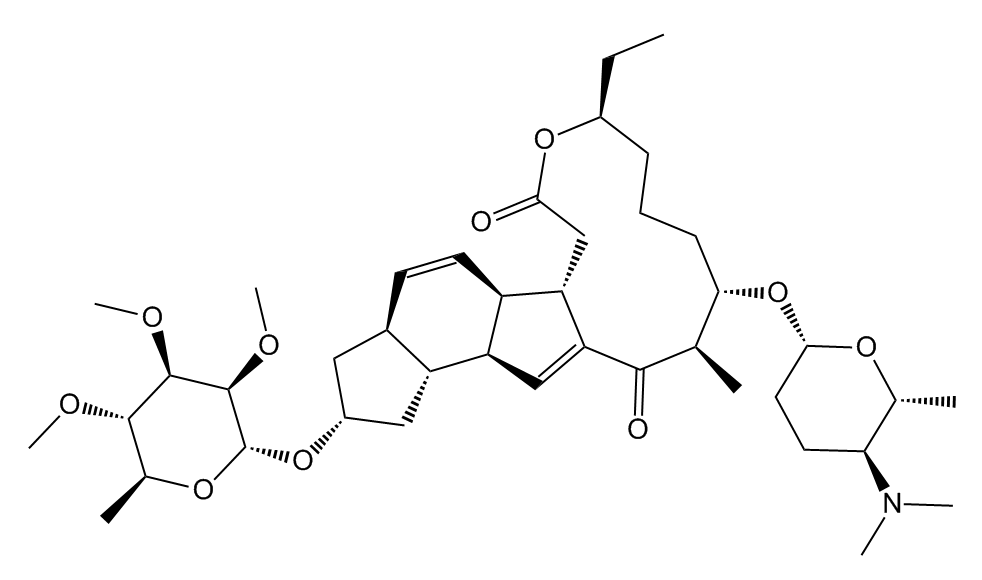
So what sorts of residues are found on the organic samples? The most common detection is of an insecticide called spinosad. That is an effective control for a variety of caterpillar pests and is produced through a microbial fermentation process, thus allowing it to qualify for use in organic (see chemical structure of one of the spinosyns below). Just to be clear, the spinosad products are produced by the Dow chemical company.

Chemical structure of a spinosan (Image from Cappacio)
Conventional farmers also make good use of this and other natural products. Spinosad is really the only natural product pesticide that is detected in the USDA’s monitoring program. Other widely used products like sulfur, petroleum distillates, copper salts and microbial products can’t be monitored using the same, highly sensitive and cost-effective tools that allow the USDA to generate the more than two million test results they generate each year. If specific tests were conducted for those natural products, the number of residues detected per organic sample would probably be much larger – but it wouldn’t really change the overall conclusion that these foods are safe to enjoy.


Other than spinosad, the remaining 80.2% of residues detected on organic are of “synthetic” chemicals.

Graph by author

While very few of the synthetic materials used in agriculture today are intrinsically very toxic to humans, they are theoretically not supposed to be present on organic because they are not on the list of approved, natural options.

There is however a rule in the organic certification system that any residue present at 5% or less of the USDA tolerance will be considered “unintentional” and thus not a reason to deny organic certification. 62.1% of the 2015 organic detections met that criterion, but interestingly so do 74.6% of the detections on non-organic samples from the US and 70.1% of the detections from imported, non-organic samples. Not so different.

Another 15.6% of residues detected on organic technically violate the organic rules by being over 5% of EPA tolerance, but such residues are still fully safe based on EPA criteria. That same safety criterion applied to 23.0% and 25.2% of conventional US and imported samples respectively. For both organic and conventional there are a few detected residues of products that don’t have a specific, assigned tolerance for the crop in question. These are generally very low-level detections, so while they represent technical violations they are not of real concern and once again, similar for organic and conventional (average “no tolerance” detection for organic 23.7 parts/billion, average for conventional imports 19.8 ppb, and average for US conventional 17.2 ppb).

To reiterate, what this transparent public database tells us is that our food supply is safe from the perspective of pesticide residues. This means that our regulatory system is working and that thousands of farmers in the US and elsewhere are doing a great job of managing pest damage while still protecting our health. The data also tells us that there are some striking similarities between organic and conventional when it comes to residues. What the data also tells us is that as consumers we should reject some of the misleading marketing and advocacy efforts of certain irresponsible elements of the organic industry. Instead of giving in to those fear-based campaigns we should feel the freedom to choose healthy and delicious produce using important criteria like freshness, flavor, quality and affordability.

There is a site you can use to visualize the PDP data http://www.cropaudit.org/

You are welcome to comment here and/or to email me at savage.sd@gmail.com