


(This post was originally published on Forbes on 8/17/22)
Humanity depends on the agriculture sector to produce our food, feed, and fiber, and that demand continues to grow. Increasingly we look to crops as more climate-friendly sources for fuels, plastics and other “bio-materials.” The challenge is to fulfill this diverse and expanding demand without driving land-use-change (LUC)- the conversion of previously uncultivated lands to farms. LUC leads to the loss of biodiversity and a massive release carbon dioxide from those soils. Through the refinement of farming practices and the use of new technologies, the productivity of many major crops has been steadily increasing (see graphs below), but climate change may compromise that trend.
 |
| The per acre yield of major US crops has been increasing for decades (Graphs by author based on USDA-NASS Quickstats data) |
 |
| A field of Camelina in bloom (image from Yield10 Bio) |
There is a newly developed version of a crop called Camelina which will allow double cropping in Northern latitudes where that was not previously possible. It has the potential to be planted on millions of acres following crops like corn and soybeans or canola in the prairie provinces of Canada and in the Northern Tier of US states.
Double cropping also aligns with the concept of “Regenerative Farming” in that it keeps diverse species growing on the land for as much of the year as possible which builds soil health. “Cover crops” are a similar option but in that case the planting is not for a second harvest. Over time both of these practices increase the drought resilience and nutrient buffering capacity of the land, and when paired with no-till management these systems result in long-term sequestration of more carbon in the soil which could add value through a carbon offset market. There is a yield and yield stability payback from the enhanced soil health, but that can take several years to accrue and so it is difficult to justify the cost of seed and fuel for a non-harvested cover crop. A cash double crop generates income while providing the same benefits. Double cropping and cover crops also provide other “ecosystem services” in that the active root systems prevent erosion and nutrient runoff during the part of the year following harvest of the primary cash crop. Although Camelina does not require bees for pollination, it’s flowers are an excellent forage resource for bees and its golden yellow blooming fields are beautiful to see. In recognition of the many benefits of double cropping, the USDA has added coverage for the practice in its crop insurance program.
Camelina closeup Camelina flowers are very attractive to bees
 |
| Camelina does not require bees for pollination, but it is a very attractive to bees and other pollinators |
Camelina is actually an ancient crop which was a common source of lamp oil and animal feed in Europe into the early 20th century. It was recently selected as a candidate for improvement by a company called Yield10 Bioscience. With the advanced breeding tools that are available today, it is possible to take a relatively unimproved crop like Camelina and rapidly develop improved versions to fit modern needs. Yield10’s initial focus has been to develop very high yielding and high oil content versions that could be used to make biodiesel and jet fuel. Yield10’s leading winter cultivars for this purpose have been scaled up for larger acreage planting this fall and the Company has a strong pipeline of proprietary genetic traits in the pipeline to further increase seed yield and seed oil content. There is also a feed meal side-product so there is a food supply element to this story as well. Yield10 is currently targeting their lines for farmers in Montana, Idaho and southern Alberta and Saskatchewan.
It is interesting to compare the trajectory of Camelina improvement to that of Canola, a related species that was transitioned starting after WW II from Rapeseed (a source of lubricant oil for steamships) to a healthy human food oil and animal protein feed crop through a multi-decade conventional breeding process in Canada. Much faster progress was possible with Camelina because of advanced genetic technologies such as “marker-assisted-breeding” and gene editing. The improvements that Yield10 has been able to achieve are dramatic even though this species has a complex allohexaploid genome (3 subgenomes, predominantly 6 copies of each gene) which means that many copies of each target gene need to be edited to achieve the desired trait. Realizing that herbicide tolerance is a key trait for farmers wanting to grow Camelina in a continuous no-till system, Yield10 has a transgenic version with that trait working its way through the regulatory process.
In the not-too-distant future, Camelina double crops could also include cultivars that take advantage of that species’ high Omega-3 fat content, and Yield10 has the rights to UK patented methods to increase the additional health-promoting EPA and DHA content of the oil. This could be a good source of vegetable oil for human food and it would make an excellent aquafeed.
So overall there is reason to be optimistic about agriculture’s ability to meet the demand for biofuels, and other bio-based materials in addition to its traditional role in providing food, feed and fiber. This new double cropping option can be a part of that solution.
(This article was originally published on Forbes on 7/18/22)
 |
| No-till Soybeans Following Corn (NRCS image) |
1870
was the first US Census in which farmers were in the
minority
(47.7%).Today, only 1.3% of Americans
are still farming and
increasingly do so on operations of over 2,000 acres. Even so, family farms still make up 98% of
our agricultural sector. Farm ownership still reflects the legacy of the Homestead Act of 1862 as a great deal of current
farmland still belongs to descendents of the 19th century
homesteaders. According to the most recent USDA Census of Agriculture in 2017,
the largest share of the US agricultural land is owned by families and
individuals (201.5 million acres of cropland and 223.8 million acres of
pastureland). Partnerships and family corporations own most of the remaining
private land with non-family corporations holding only 3.1 million acres of
cropland and 6.4 million acres of pastureland (see graph below)
 |
US agricultural land is mostly in the hands of families and individuals, many with ties to to historic farming families |
The
remaining farmers have typically expanded their operations by renting additional
acres rather than by purchasing land. That approach makes perfect sense in the
high risk, moderate reward business of farming the likelihood of a year with
bad weather or low commodity prices makes it too risky to take on a big
mortgage. In the USDA’s TOTAL Survey from 2014, rented land accounted
for around 28% of US pastureland (~144 MM Acres) and 54% of US cropland (~214
MM Acres). That survey also found that
31% of farmland (pasture and crop) was rented from “non-operator landlords” and
8% from farmers (see graph below)
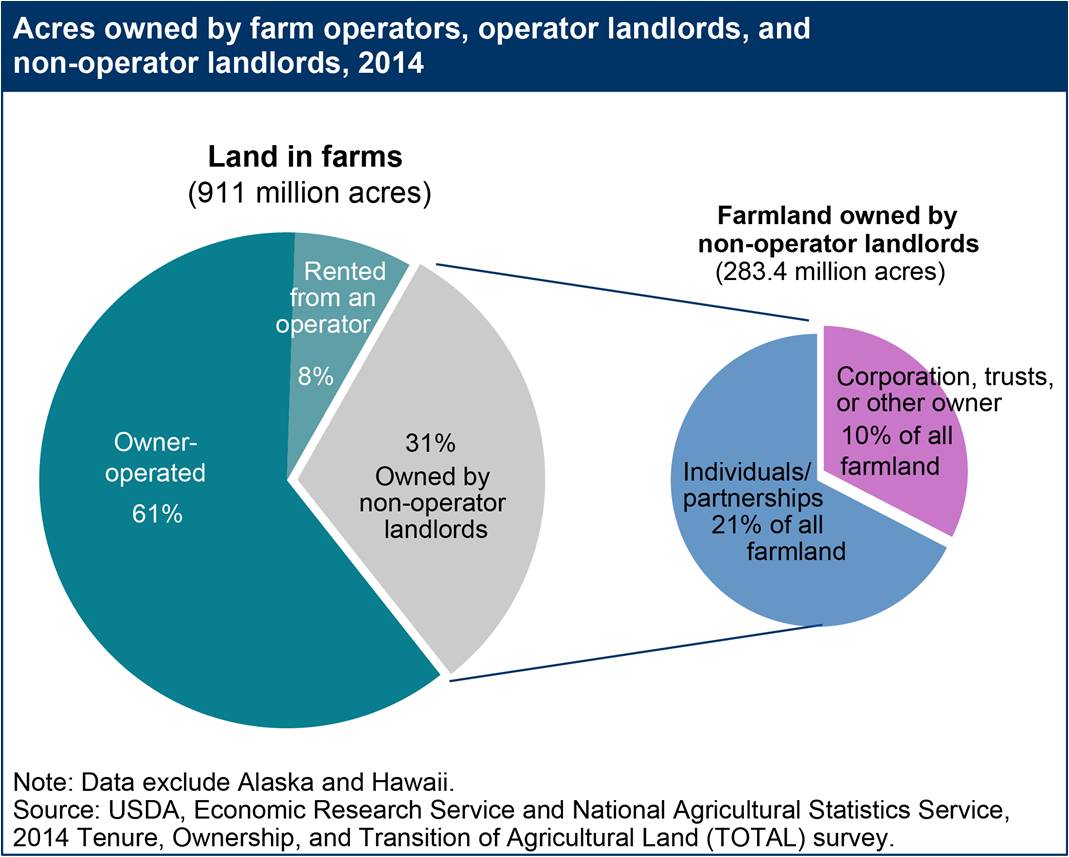 |
The land that farmers rent is mainly from non-farmers (31%) and the landlords are either individuals, partnerships, family corporations or trusts |
Farm
operations that rent some or all of their acreage dominate in all but the
smallest farm size categories (See chart below with partial rental operations
in light blue and full rental operations in orange).
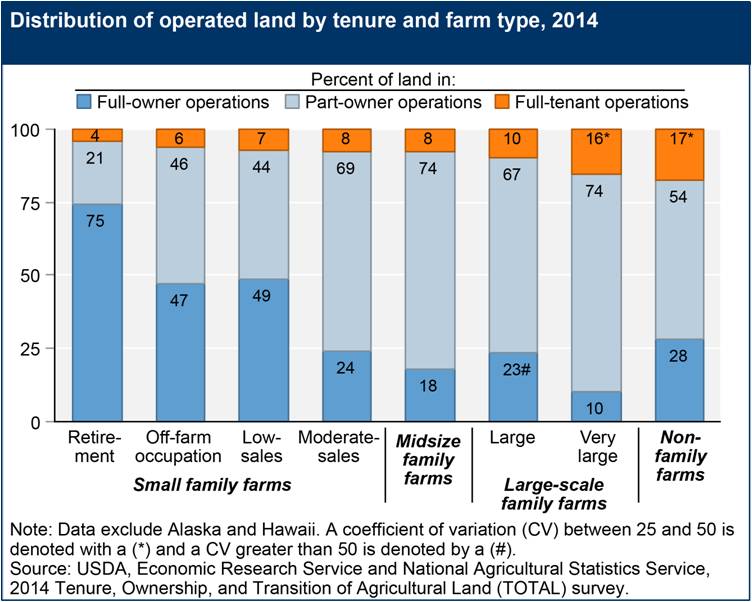
The majority of farming operations include at least some rented land. (USDA ERS and NASS)
The
landlords who lease this property are a mix of still-active farmers, retired
farmers, farm widows, city-dwelling descendants of farm families, and some
unrelated investors. Many of these landlords have a hands-off relationship with
their farmer tenant and simply collect their annual rent payment directly or through
a farm management company. In an age of climate change there are good reasons
to consider a more active role for these owners.
Agricultural
land is an asset with both short and long-term value. It generates annual
income for the farmer and a significant portion of that is applied to rent if the
property is owned by someone else. Ag land rental rates are closely tied to
historic and regional production history – better land commands higher rent. Around 1/2 of the cropland in the highly
productive Midwest is rented and the percent of land rented from non-farmer
owners is highest in the states with the highest rental rates driven by their
productive potential (see graph below).
 |
In the major farm states, the percent of land leased from non-farming owners is highly correlated with rental rates which are linked to yield potential for key crops
| GRAPH BY AUTHOR BASED ON USDA DATA |
 |
Land rental rates are highly correlated with property values within these seven USDA regions. In the Northeast and Western Pacific states other factors tend to drive property values. GRAPH BY AUTHOR BASED ON USDA DATA |
Climate
change is creating both new risks and new opportunities related to the annual
and long-term value of agricultural land. On the risk side, agricultural
productivity in any given growing season is intimately linked to weather. The
shifting climate exposes crops to more frequent extreme weather events
(drought, flooding, wind…), yield-robbing warmer nights, and increases in the
range and severity of pest challenges. Farmers can get some relief through
government subsidized crop insurance, but there could eventually be the need
for some risk sharing by landlords.
On the
opportunity side, plants can capture carbon dioxide from the atmosphere and
store it underground in relatively stable forms of organic matter – this is one
means of climate change mitigation through carbon sequestration. There are
certain farming systems that focus on the improvement of soil-health, and they do
a particularly good job of carbon sequestration. If this kind of “climate-action
farming” could be implemented at large scale (e.g. 100+ million acres), it
would be of great benefit for society as a whole. There is a further upside
associated soils that have captured and stored a lot of carbon – they become
more resilient in the face of climate change because they are better able to
capture and store rainfall in ways that buffer crop yields in both excessively
wet and dry years. The land becomes more “climate-resilient.” While there is no
one system suited to all situations, the basic elements are keeping plants growing
in a field to feed the soil ecosystem for as much of the year as possible
(double cropping, cover crops), having different species there over time including
some which are particularly deep rooted (diverse rotations), and most
importantly doing all of this with little to no mechanical soil disturbance in
the form of plowing or tillage since that sort of operation leads to the
release of sequestered carbon. There are also benefits from certain livestock
integration practices.
While
dual climate-resilient/climate-action farming systems are very attractive
as concepts, it is not at all trivial for a farmer to implement them in the
real world. They must also be customized to fit different soils types, regional
climates and primary cropping options. These changes require upfront investment
in things like seeds or equipment. There may be reduced income from some of the
rotational crops chosen for their soil enhancement characteristics rather than
profitability. It also typically takes 3-5 years years for the yield and yield
stability benefits to kick in and so the key hurdle is financing the transition.
These changes are difficult enough to justify for land the farmer owns, but far
more difficult to justify for rented land. It will be increasingly important to
educate landowners that there will be a growing perverse
incentive for a future tenant to “mine” the soil of nutrients for a few years
by tilling --- essentially what the original sodbusters did. That future conventional tiller will actually
pay more to lease the ground, knowing that his non-land operating costs will be
lower than on his/her other fields. An
unwitting landowner might think this is a good deal and switch tenants for a slightly
better rent offer --- not appreciating the asset degradation the land is about
the suffer in the background. It is a
poor trade, but not very visible. This
has been a major source of friction in some communities.
There
are initiatives underway to pay farmers to sequester carbon, but there is considerable
skepticism as
to whether such programs offer enough money to justify the costs and
complications involved. There are also questions about whether these programs
can be administered in a way that is fair and verifiable. Hopefully carbon
markets will contribute towards more climate-ready farming, but other
mechanisms are needed to enable the extensive and timely adoption of climate-resilient
farming needed to protect the food supply.
The
farming methods described here are related to what is variously defined as “Regenerative
Farming.” Unfortunately there is an effort to link the regenerative designation
to organic through a certification process that would continue the
ideologically-driven technology limitations of organic. The organic business
model is to compensate the farmer for lower crop yields through consumer-paid
price premiums, and that is not a workable approach to drive the system change
on a large sale in row crops. The shift to climate-resilient farming methods
needs to be enabled by all the best available technologies including
biotechnology and well regulated crop protection chemicals.
Yes,
there is reason to believe that this is possible based on a historical precedent
for a farming huge system paradigm shift that happened in mainstream
agriculture: “no-till farming”. That change was also a response
to a climate crisis of human origin – the Dust Bowl
phenomenon of the 1930s, and it demonstrates the fact that farmers can make
changes when they need to. This year marks the 60th anniversary of
the first “no-till” field grown in Kentucky in 1962. Growing crops without
plowing or tillage was such a radical idea that early adopters had to avoid
social gathering spots like coffee shops to avoid getting harassed about their
“trashy fields.” Fast forward to 2017 and 104.5 million US acres were farmed
using a no-till approach. No-till or the
related Strip-till farming methods are the ideal
foundation for the full suite of climate ready systems, and so it is important to consider what
enabled that kind of large-scale change. The key elements were applied public
research, the development of specialized machinery, and the availability of key
technologies such as herbicides and biotech crops. But perhaps most importantly, the change was pioneered
by a distinct and innovative subset of the farming population. Today there are
still self-identified “no-tillers” and “strip-tillers,” and they are at the adoption
forefront of other farming methods that enhance climate-resilience. Grower
oriented publications like No-till Farmer or Progressive Farmer are filled with narratives about
farmers that are working out the practical details of adding things like cover
crops or unusual rotations or livestock integration. The key is not to tell
growers how to farm, but rather to ask these leaders what works and what would
help them and others to move in the right direction in terms of a climate
change response.
As
mentioned earlier, it can take several years for the crop yield benefits of
modified farming practices to kick in and typical leases are on an annual cash
basis. Longer leases would be a step in
the right direction, but probably not all that is needed.
As
the growing climate becomes more challenging, land with enhanced climate
resilience will become more valuable, both in terms of potential rent and as a
premium property. It would make sense to structure a lease to include some cost
sharing between the farmer and the owner during the transition process, and
then have some mechanism for the farmer to share in the for the increased rent
potential and land value. There would also need to be a cooperative lease model
for land that is going to be enrolled in a carbon market program. Getting
carbon credits requires a commitment to the “permanence” of the carbon sequestration
which is not something that a renter can promise since a subsequent renter
could return the land to full tillage and release the stored carbon back into
the atmosphere. A land owner who wants to have their land in a carbon program
will need to find a capable and willing farmer and it would be appropriate to
do that with some sort of cost and value sharing arrangement.
Another
possibility would be to identify farmers with the most experience with transitioning
to climate-ready farming methods, and engage them to upgrade land that hasn’t
been optimally farmed in the past. Once again a cost sharing arrangement would
be appropriate up front followed by some mechanism for the grower to share in
the upside value. It would also make sense to set up an apprentice-like
arrangement for young farmers to learn from those same experts.
In
order for there to be widespread adoption of new lease models that support
climate-ready/climate-active farming, to be there needs to be a way to connect
progressive farmers with enlightened landowners and other entities. The goal is
not to tell farmers how to farm, but rather to enable them to optimize the
climate resilience of land in ways that make sense for specific settings. There
could be a role for environmental or climate-action NGOs to generate interest among
non-farming land owners and provide them with background information and lease
models. Federal and state agencies involved with agriculture as well as farm
industry organizations could help in the development of the new lease models.
The operators of carbon offset programs should clearly “be at the table” as
should individuals or organizations who want to invest in farmland. There could
be a role for entities pursuing corporate sustainability or climate goals.
There could be a role for climate-oriented charitable foundations. On the
surface these diverse groups might seem like “strange bread-fellows,” but with
a commitment to mutual listening and respect, they could join forces to make a meaningful
difference for the future of the food supply and the trajectory of climate
change.
 |
| Asian Citrus Psyllid Adult (image USDA-APHIS) |
 |
| Ever since HLB appeared in 2005, production has been dropping (graph by author based on USDA-NASS data) |
 |
| Orange production has dropped both because of reduce acreage and because of declining yield per acre. This has also been true for other citrus types (Graphs by author based on USDA-NASS data) |
 |
| There is an orange grove under this protective cover designed to completely exclude the insect vector of HLB (Arnold W. Schumann, University of Florida/IFAS) |

